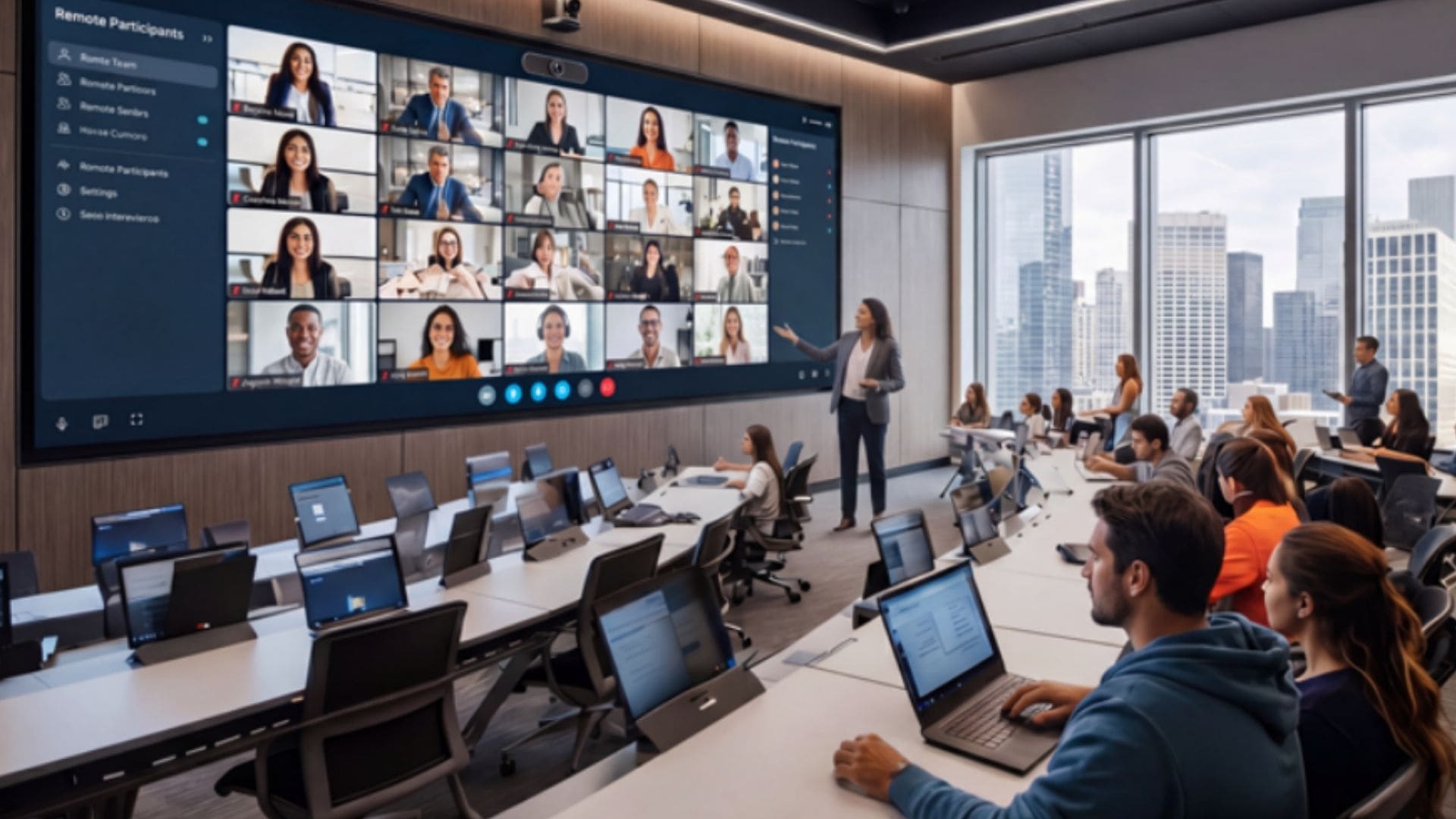
The boundaries distinguishing physical learning environments from digital interfaces have entirely dissipated. What was once celebrated as the “hybrid classroom,” a reactionary, pandemic-era solution relying on static cameras and isolated Zoom feeds, has evolved into a highly sophisticated, permanently unified architectural standard: The Phygital Classroom.
For contemporary higher education and enterprise training spaces, “phygital” signifies a profound design philosophy where physical architecture and virtual learning platforms are seamlessly integrated through an automated, hardware-software interconnected AV ecosystem. This paradigm emphasizes spatial equity, ensuring that remote students or participants are as cognitively engaged, visually represented, and acoustically present as their colleagues seated in the front rows.
Achieving this necessitates a departure from fragmented hardware components. Modern technological integration concentrates on deploying intelligent, self-orchestrating AV environments driven by edge computing, automated software, and multi-layered hardware configurations.
Phygital architecture: Four pillars of integrated AV ecosystems
To establish an equitable learning landscape, an AV ecosystem must operate as a unified, distributed computing network rather than a series of disconnected inputs and outputs. Integrators and technology architects are designing these contemporary learning environments based on four fundamental technical pillars.
1. Cognitive audio and beamforming environments
In an interactive classroom environment, the quality of audio is the primary indicator of participant fatigue. If a remote learner is unable to hear a whispered question from a student at the rear of the lecture hall, their cognitive engagement significantly diminishes.
Modern architectural designs incorporate ceiling-mounted multi-element beamforming microphone arrays, which are directly connected to localized Digital Signal Processors (DSPs). Instead of simply covering a room with generic audio capture, these microphone arrays utilize automated tracking zones to immediately focus acoustic “beams’ on the active speaker, effectively suppressing ambient HVAC noise and room reflections.
On the output side, multichannel, zoned spatial audio reinforcement systems accurately map remote voices to physical loudspeakers positioned closest to the location of their digital video avatars. This innovative spatial alignment provides natural directional cues to the physical instructor.
2. Intelligent computer vision and automated framing
The days of compelling an instructor to remain perfectly stationary behind a podium are gone. Phygital ecosystems employ distributed multi-camera networks equipped with AI-powered computer vision algorithms.
These integrated systems continuously analyse the physical environment utilizing skeletal tracking and facial recognition to automatically coordinate camera perspectives without human intervention. When an instructor moves to a physical whiteboard, the system seamlessly transitions to an optimal camera angle while implementing real-time keystoning corrections to digitally flatten and enhance handwritten text for remote viewers. Concurrently, secondary tracking cameras supervise the student gallery, instantly cropping and framing local participants when they speak to provide high-definition close-ups directly to the virtual platform.
3. Unified hybrid canvases and spatial telepresence
To achieve true interaction parity, physical classrooms require extensive digital real estate. Standard 16:9 projection screens are rapidly being replaced by ultra-wide, panoramic Direct-View LED (DVLED) displays with customised aspect ratios (such as 21:9 or 32:9).
These oversized canvases are driven by advanced media servers that run unified collaboration interfaces (e.g., Microsoft Teams Rooms Front Row or Zoom Rooms). By dedicating the bottom portion of a massive, life-sized display to eye-level video feeds of remote students, the physical instructor can maintain natural, unforced eye contact with both physical and virtual groups simultaneously. The remaining segments of the display dynamically allocate space for interactive course content, real-time chats, and digital whiteboards, keeping all vital materials fully visible in a single cohesive view.
4. Hardware-software co-design and orchestration
At the core of the phygital space is the tight alignment between hardware components and the unified software layer. A truly integrated ecosystem operates on a distributed architecture in which edge hardware communicates natively with cloud-hosted platforms.
Networked AV-over-IP (AVoIP) encoders and decoders route uncompressed, ultra-low-latency 4K video and multi-channel audio over standard enterprise network infrastructure. Centralised control processors serve as the room’s physical brain, listening for API triggers from the collaboration software. When a user launches a virtual learning session, the room automatically responds: lighting grids shift to pre-configured video profiles, audio routing tables reconfigure to accommodate remote callers, and environmental sensors monitor air quality and occupancy to ensure optimal comfort.
The integrator’s blueprint for phygital delivery
For AV integrators, consultants, and IT directors, planning and building an effective phygital classroom requires moving away from the traditional approach of compiling disparate product datasheets. True integration demands a rigorous, lifecycle-focused implementation framework.
The next horizon: Intelligent, context-aware learning spaces
As we look to the future, the phygital AV ecosystem will continue to evolve from a reactive system to an active, context-aware collaborator. The ongoing integration of lightweight Artificial Intelligence engines and real-time learning analytics into localised AV control processors is paving the way for classrooms that adapt dynamically to human behaviour.
Future-proof control processors will soon go beyond tracking a speaker’s physical position. They will monitor anonymised spatial acoustics, engagement analytics, and real-time environmental data to dynamically modify the learning landscape. If a localised microphone array detects a drop in vocal energy or ambient noise disruption, the DSP will instantly re-profile the audio matrix, while the environmental control loops optimise lighting and air delivery to maintain student focus.
For AV professionals, the objective is crystal clear. We are no longer simply mounting displays, running copper cables, and balancing audio frequencies. We are building unified, highly responsive computational environments. By prioritising hardware-software harmony, spatial equity, and open API standardisation, the modern AV integrator is designing the architectural foundation of modern education, one seamless phygital space at a time.