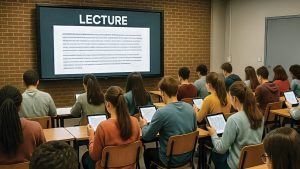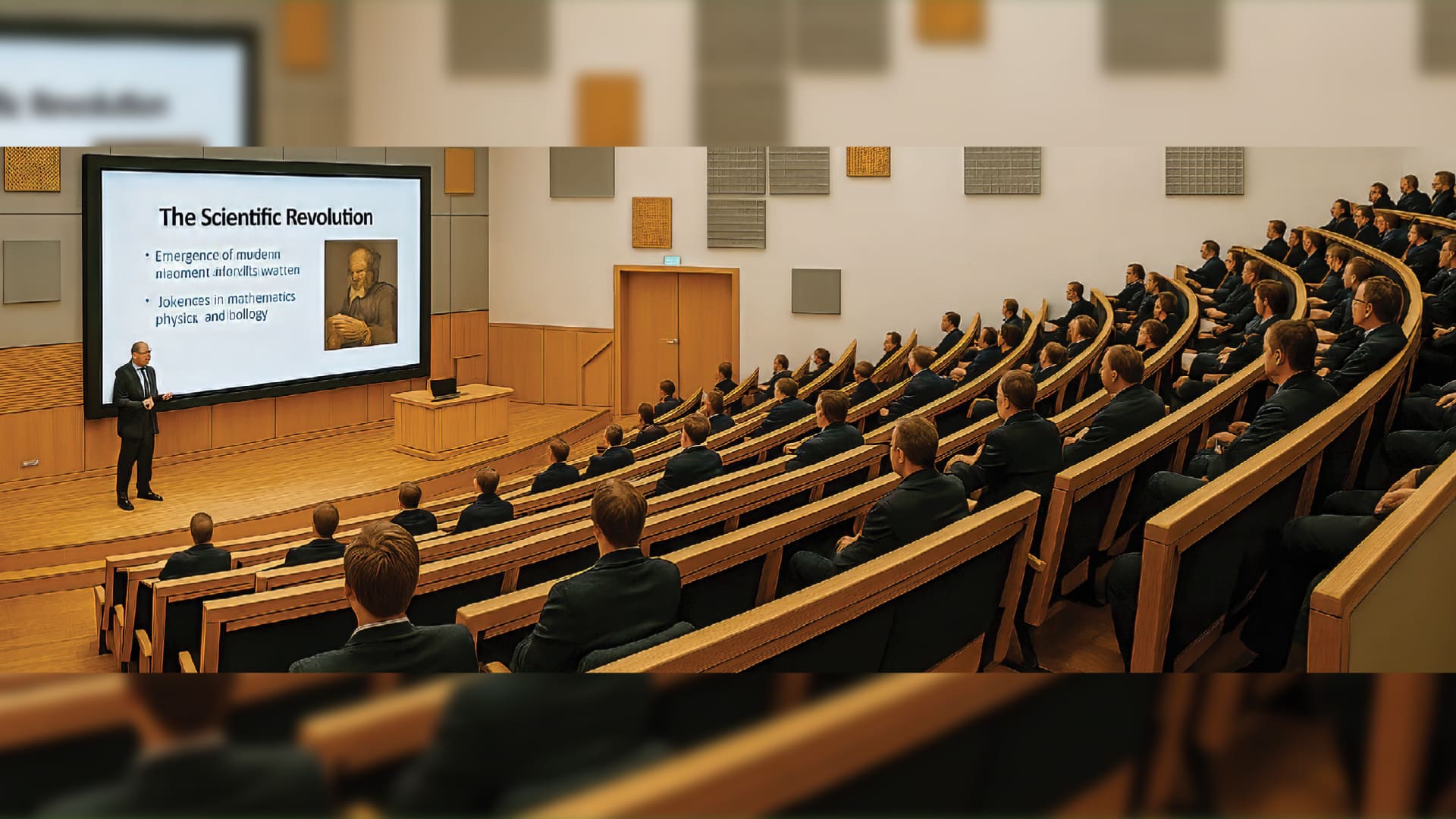
Learning environments often overlook a crucial element that significantly impacts education outcomes: ‘Acoustics’. When students sit in classrooms surrounded with noise levels that either match or exceed their teacher’s voice, they are compelled to decipher instruction amidst an overwhelming auditory clutter. It is this veritable ‘sea of noise’ that impedes focus and hinders comprehension.”
This article explores the importance of acoustic design in educational spaces, identifies common problems and offers practical solutions.
Poor acoustics create serious challenges for students. When children can’t understand 20-30% of what’s being said in class, their learning suffers—especially for primary students and non-native speakers. The struggle to hear clearly increases cognitive demand, leading to frequent misunderstandings and problems with language processing, memory, attention and concentration.
The psychological and physical impacts extend beyond academics. It has been observed that, students experience elevated stress levels, anxiety, increased annoyance, disrupted sleep, and fatigue. Teachers on the other hand, have often experienced vocal strain as they instinctively raise their voices in order to counteract the background noise in a phenomenon known as the ‘Lombard effect’, which often results in occupational voice disorders and increased absenteeism.
Sources of Classroom Noise
Classroom noise comes from both external and internal sources. External noise enters through the building envelope and typically includes traffic sounds, industrial noise, equipment noise and the noise of people outside school. Urban schools particularly struggle with traffic noise.
Internal noise sources include those that emanate from the usage of teaching equipment (computers, projectors), building services and the sound that is transmitted through the walls, floor, ceilings or from other areas of the school. However, in primary school classrooms, the dominant noise source is often the students themselves especially when they participate in various activities.
These acoustic challenges significantly impact learning outcomes and teacher wellbeing. Research shows that excessive noise can reduce cognitive performance, increase stress levels, and impair speech intelligibility, especially affecting students with hearing impairments or language barriers. Proper acoustic design incorporating sound-absorbing materials, strategic classroom layouts and noise policies can dramatically improve the learning environment. Modern educational spaces must balance collaborative activities with appropriate noise management techniques to create optimal conditions for both teaching and learning.
The Reverberation Problem
One of the biggest issues in acoustically untreated classrooms is reverberation—sound reflecting off hard surfaces like walls, floors and furniture. These reflections interfere with the original sound source, distorting it and reducing speech intelligibility. In spaces with many audio sources (like students talking), excessive reflections significantly increase noise levels—similar to what happens in crowded restaurants. Reverberation is measured in time, with RT60 being the time taken for sound to decrease by 60dB.
Research indicates that optimal classroom RT60 values should range between 0.4-0.6 seconds, yet many educational spaces exceed 1.0 second or more. This prolonged reverberation creates a challenging learning environment, particularly for younger students whose auditory processing skills are still developing and for those with hearing impairments or learning disabilities.
Common Design Failures
Many designers and architects lack awareness about the importance of acoustics, resulting in:
- Hard, reflective surfaces (concrete, glass, tile) that echo and reverberate
- HVAC systems and external noise (traffic, hallways) raising background noise levels
- Poor speaker placement or inadequate PA systems that distort audio
- Insufficient absorptive materials in strategic locations to capture sound reflections
- Rectangular shaped rooms that create standing waves and flutter echoes
- Failure to implement acoustic isolation between adjacent learning spaces
- Overlooking the unique acoustic needs of specialized learning environments such as music rooms, language labs, and open-concept collaborative spaces
Best Practices for Classroom Acoustics
Controlling Reverberation
The ‘Reverberation Time’ should be minimized to optimize learning. This can be achieved by installing sound-absorbing materials with high absorption coefficients, such as acoustic wall panels, treated ceiling tiles, soft seating, carpets and drapes. Hypoallergenic materials should also be used whenever possible.
Lower ceilings help reduce room volume, thereby decreasing the reverberation. Consulting acoustic specialists and speech-language pathologists during planning and remodeling ensure optimal conditions for student learning and teacher vocal health.
Reducing Background Noise
The walls between classrooms, hallways, and outdoor areas should be properly sealed acoustically, with no gaps between the walls, ceilings, and floors. Speech from neighboring classrooms should not be intelligible, and noise from the hallways and outdoors should be minimized.
Furniture noise can be reduced using noise-dampening feet or pads. Low-noise HVAC systems likewise will decrease the mechanical noise in the room.
Sound Field Amplification
The reinforcement of sound should be considered in larger rooms to improve speech intelligibility for students seated farthest away from the teacher. This approach also reduces the vocal stress on educators.
These systems greatly improve signal levels since only the voice at the microphone is amplified, not the background noise. Research supports signal-to-noise ratios ensuring a teacher’s voice is at least 20 decibels louder than the background noise.
For best results, small speakers should be evenly distributed throughout the room rather than using a single loud speaker at the front, to improve clarity and consistency.
Room Geometry
Designers should avoid parallel walls and flat ceilings whenever possible. Introducing angled surfaces or diffusers instead to scatter sound effectively, could be a better idea.
Design Guidelines
International standards provide specific guidance for acoustic design in educational spaces:
WHO Guidelines for Maximum Noise Levels and Reverberation Times in Schools
|
Space |
Noise Level, dB LAeq |
Reverberation Time, seconds |
|
Classrooms |
35 |
0.6 |
|
Halls and cafeterias |
– |
< 1 |
|
Outdoor playgrounds |
55 |
– |
The classroom background noise level of 35 dB(A) assumes a typical teacher’s voice level of 55 dB(A) at one meter distance, allowing for a signal-to-noise ratio of 15 dB. These guidelines note that both background noise and reverberation time should be lower for hearing-impaired children.
ANSI S12.60-2002: Maximum Background Noise Levels and Reverberation Times in Learning Spaces
|
Volume of space |
Background noise level, dB LAeq, 1hour |
Reverberation Time, seconds |
|
< 283 m² |
35 |
0.6 |
|
> 283 m² and ≤ 566 m² |
35 |
0.7 |
|
> 566 m² |
40 |
– |
This American standard (ANSI) also includes sound insulation requirements between learning spaces and adjacent areas. For example, the minimum Sound Transmission Class (STC) between two learning spaces is 50, between a learning space and corridor is 45, and between a learning space and cafeteria is 60.
Moving Forward
The future of acoustic design in educational spaces requires treating acoustic quality as an equity issue within inclusive design principles. This means integrating acoustics into early planning stages and adopting a cross-disciplinary approach involving architects, engineers, and educators.
By prioritizing sound quality in learning environments, we create spaces where all students can clearly hear, focus, and thrive—transforming noisy classrooms into effective centers for learning and development. Research consistently shows that students in acoustically optimized environments demonstrate improved comprehension, higher test scores and better behaviour patterns. Educational institutions must recognize that acoustic design is not merely a luxury but a fundamental component of educational access, particularly for neurodivergent learners and those with sensory sensitivities. Acoustic improvements represent one of the most cost-effective interventions available to schools seeking to enhance educational outcomes and create truly inclusive learning communities.
 Prashant Nair, founder of KKS, is a passionate audio professional with nearly two decades of experience. He began his career at BOSE and has since led numerous large-scale audio installations, including high-performance systems for luxury hotels like Taj. Deeply driven by sound excellence, Prashant blends audio precision with practical acoustics to deliver transformative listening environments.