
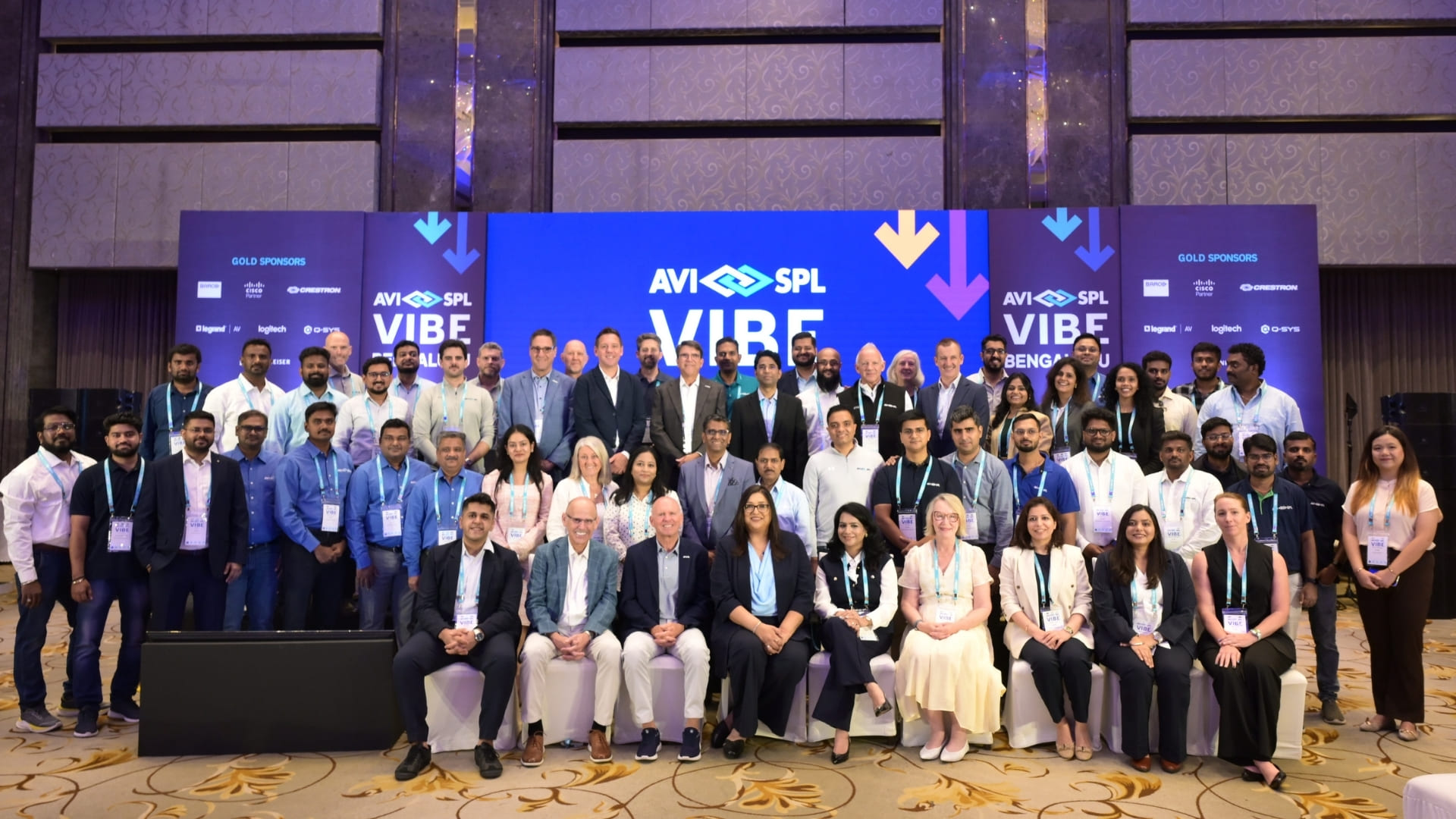
The AVI-SPL Senior Vice President believes the industry’s next chapter will be written not by technology alone, but by leadership,
adaptability and the courage to rethink business models that have served for decades.
Artificial Intelligence has become the dominant topic in every boardroom, every conference hall, and every technology conversation today. Yet for Julian Phillips, Senior Vice President at AVI-SPL, the industry keeps asking the wrong question.
During a recent visit to Bengaluru for AVI-SPL VIBE 2026, Julian offered a view that runs counter to much of the current conversation. AI, he argues, is not the story. It is a symptom of a much bigger shift already reshaping how businesses create value and how they will need to operate to survive it. For an AV industry accustomed to being called in at the end of the project, that shift is both an unprecedented opportunity and a real threat to anyone who chooses to wait it out.
The end of the predictable World
Julian believes many industry leaders are misreading the moment. The noise around AI suggests businesses are simply riding out another technology cycle, as they did with cloud, mobile, or unified communications before. He sees something bigger underway.
The world that shaped business decisions for the past several decades rested on a reasonable degree of predictability. Companies could plan investments, build long-term strategies, and operate in relatively stable markets. AV integration businesses were built on those same assumptions, and by that measure, most industry leaders made entirely sensible decisions at the time.
What specific steps can industry leaders take to evaluate whether their current business models are adaptable to the rapidly changing environment, especially given the shift from predictable markets to more volatile ones? This will help readers apply Julian’s questions in their strategic planning and foster proactive reinvention.
From project responders to strategic contributors
Julian foresees a major change in the AV industry’s role, shifting from a late-stage, technology-fitting service to an early-stage contributor in workplace and digital strategy planning.
He criticises the industry’s current position, where AV professionals see themselves as lowly, only involved after architecture and design are complete. Julian stresses that this mindset must change first, with AV experts participating early in planning to shape specifications, not just respond to them.
The battle between FOMO and FOJI
Throughout the conversation, Julian kept returning to two ideas that stood in tension with each other, FOMO – the fear of missing out, and what he calls FOJI – the fear of joining in. Business leaders clearly see the opportunity in AI, automation, data, and new service models. They know change is underway, but engaging often means questioning proven practices, and the fear of getting it wrong often outweighs the potential benefits. Julian argues that overcoming FOJI is now crucial for industry leaders.
Success won’t necessarily go to those with the biggest budgets or newest tech, but to those willing to experiment, learn publicly, and adapt before market forces push them.
Why AI is not the starting point
Julian, despite being bullish on AI, insists it shouldn’t be the starting point for transformation. He advises understanding the business first, including its vulnerabilities and model, before focusing on efficiency. Efficiency often misleads companies into chasing speed without clear customer needs, leading to worse outcomes. AI should amplify a business’s true value, not replace understanding. Technology is only effective when targeted at clearly identified problems.
The efficiency trap
AVI-SPL’s transformation follows the same logic. The company established an AI Center of Excellence and hired AI strategist Sol Rashidi, emphasising that the goal isn’t to cut headcount but to eliminate repetitive, low-value tasks, freeing staff for creativity, customer relations, innovation, and strategic thinking.
Julian believes that cultural perception is as important as technical implementation: organisations perform better when employees view AI as a frictionless tool rather than a threat to their jobs. Removing fear encourages experimentation, where valuable learning occurs. Julian believes that, even amid automation, human judgement remains essential for customer value.
Storytellers, connectors, real-timers
Ask Julian what the AV industry actually does, stripped of products and project categories, and he doesn’t hesitate. He points to Yuval Noah Harari’s Sapiens and its argument that humanity’s defining trait is the ability to construct shared stories and convince others they are real, which is how money, companies and entire civilisations came into existence in the first place.
“Understand what we do in the AV industry. There are three elements,” he said. “We’re storytellers. We help people tell their story. We’re connectors. We help people connect with others and build connections. And we’re real timers.” Nearly every AV application, he pointed out, happens live: a CEO delivering results to ten thousand investors, a presenter on stage, a microphone that simply has to work, right now, with no second take.
He argues that AV differs from IT, which operates on near time, with cloud and managed services focused on five-nines uptime and four-hour responses. However, four hours is irrelevant to AV since the presentation ends before then. Julian states, “The IT industry is built around near time, and we’re built around real time,” emphasising that AV’s competitive edge is its real-time nature, especially as AI influences technology. He admits the industry must move beyond seeing itself as a lesser part of others’ projects.
Beyond meeting rooms: The transformation economy
Julian believes future business growth lies beyond unified communications, inspired by The Experience Economy by Pine and Gilmore, which prioritises experiences over goods and services and even higher-level transformation.
He cites his Experience Technology Group (XTG), launched five years ago, now comprising about a third of AVI-SPL’s revenue and growing faster than traditional UC, indicating industry health isn’t solely reflected by meeting-room demand.
That bigger picture is taking shape through AVI-SPL’s new Enterprise Mission Critical practice, which uses Model Context Protocol to extract an organisation’s data from its silos, normalise it, and connect it to AI models, giving a company like a bank a real-time view of what a geopolitical shock or market move means across its business.
“If we in the AV industry can build these environments that help people do that, where do you think our value lies now?” Julian asked. “We’re no longer the guys who just build conference rooms. We’re the guys who help them drive their value in the stock market.”
A trillion-Dollar opportunity
The global AV market is roughly $340 billion, but Julian believes it could triple to a trillion by embracing experience, service, data, AI, and transformation-led models. He sees this as a mindset issue, overcoming FOMO and FOJI. Staying afraid means missing growth, but pushing through can fundamentally transform companies and their people.
Conclusion
Underneath the provocation, Julian’s message is ultimately optimistic. He does not see AI as a threat to the AV industry, and he isn’t arguing for a wholesale rejection of the models that built the successful companies operating today. He argues that the industry is standing at the edge of its biggest opportunity yet, and that the obstacle in front of it isn’t technological at all. It’s cultural. It’s strategic. It’s a question of whether leadership is willing to grow into the value it already creates, rather than settling for the smallest version of the job.