The schoolroom of yesterday is vanishing. Gone are the days when learning meant sitting quietly in rows, copying notes from blackboards, and memorising facts for exams. Today’s classrooms buzz with conversation, collaboration, and creativity. Students don’t just listen anymore, they question, explore, create, and teach each other.
This transformation, known as active learning, treats students not as empty vessels but as curious minds eager to engage with ideas. From universities in Chile to village schools in India, this approach proves that when students become active participants in their education, they actually learn. And critically for the AV industry, this shift requires completely reimagining classroom infrastructure.
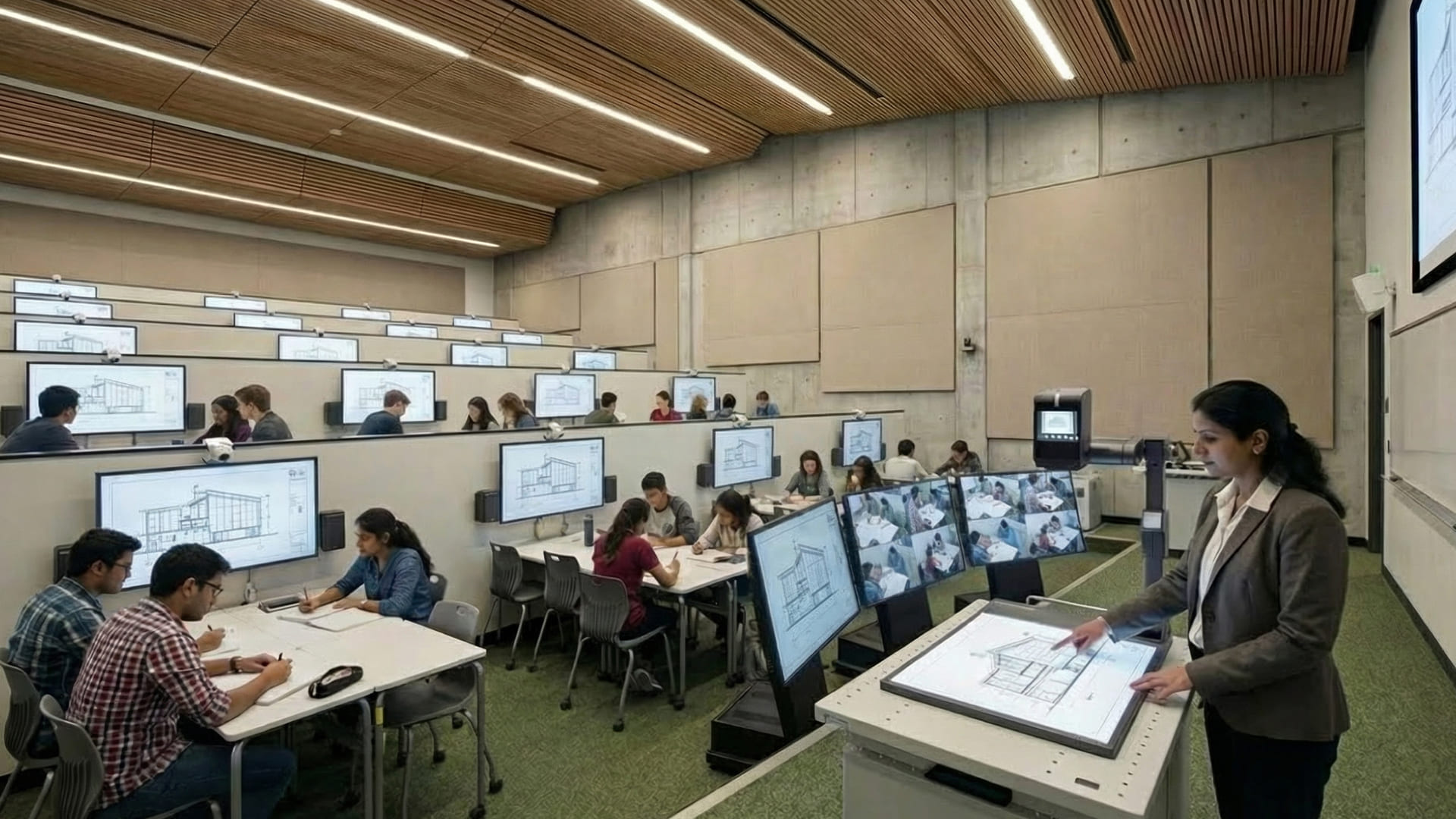
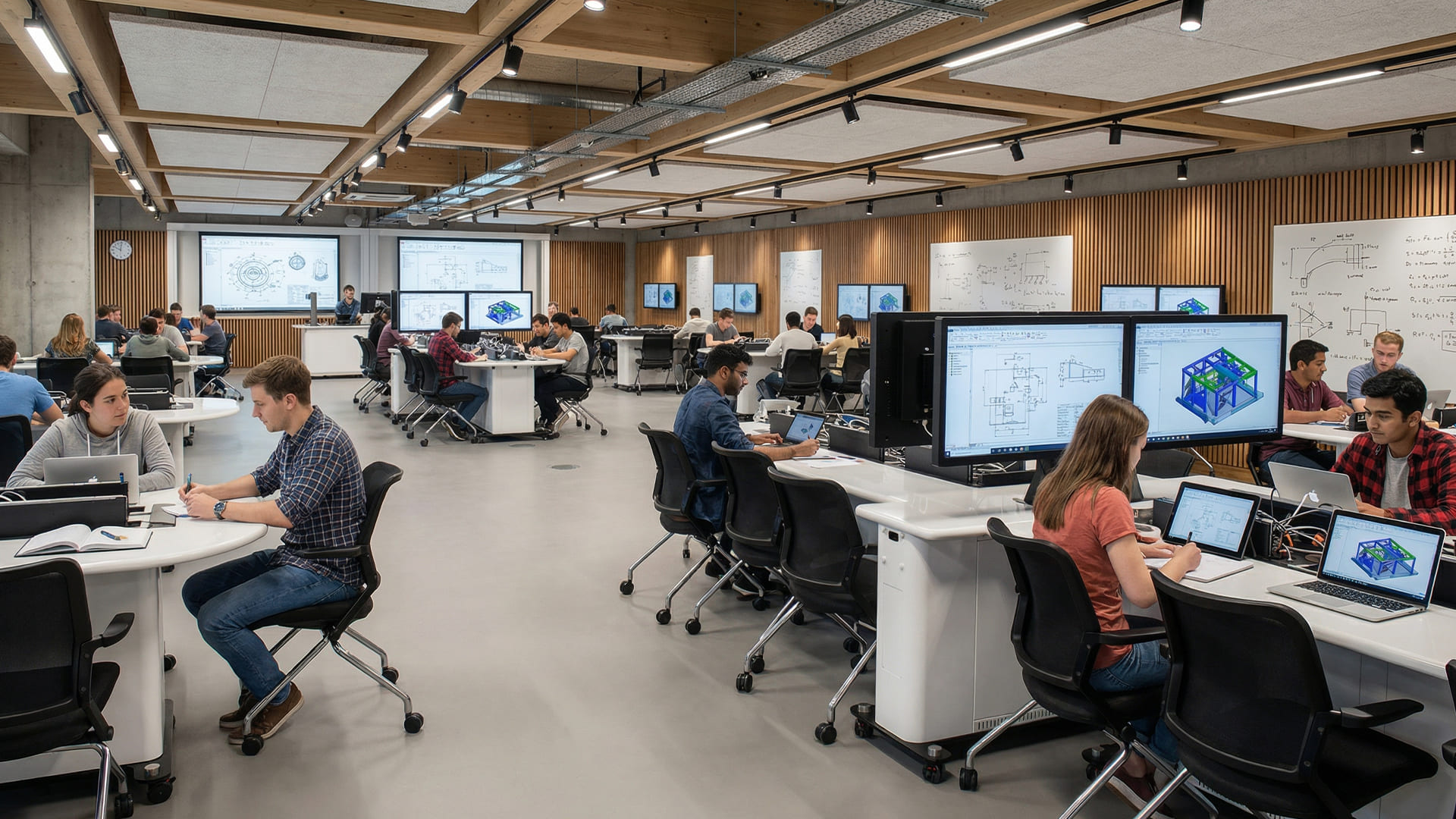
Walk into a modern active learning classroom, and you’ll notice the difference immediately. The teacher isn’t standing at the front delivering a monologue. Instead, students are gathered in small groups, debating a problem. Someone is sketching ideas on a whiteboard while others pull up research on their tablets. A few students are presenting their findings to classmates, fielding questions and defending their conclusions. The teacher moves between groups, asking probing questions, nudging thinking in new directions, listening as much as speaking.
This isn’t chaos, it’s learning in action. Research consistently shows that active learning improves not just how much students remember, but how deeply they understand. When a physics class in a leading institution switched from traditional lectures to active problem-solving sessions, something striking happened. Students who had struggled with formal reasoning, those who typically failed, suddenly performed much better. The hands-on approach gave them a way in, a chance to grasp concepts that had seemed impossibly abstract in lecture format.
The shift represents a fundamental rethinking of what a teacher does. Rather than being the broadcaster of information, the teacher becomes a facilitator, a guide who designs experiences and coaches students through challenges. It’s harder work in many ways, but also more rewarding. Teachers report that once students get used to active learning, they become more engaged, ask better questions, and take genuine ownership of their education.
The Technology Foundation
Technology has become the invisible infrastructure that makes active learning possible at scale. Interactive displays replace static blackboards, allowing teachers to pull up videos, annotate diagrams in real-time, and let students share their work with the whole class. Wireless systems mean anyone can project their screen instantly, no fumbling with cables, no waiting, just seamless sharing of ideas.
Document cameras and visualizers have found new life in this environment. A biology teacher can place a specimen under the camera and zoom in on details while students watch on the big screen, discussing what they observe. A math instructor can work through a problem on paper, showing their thinking process step-by-step, pausing when students have questions. It makes abstract concepts tangible.
Audio systems matter more than you might think. In a room full of discussion and group work, everyone needs to hear clearly. Modern systems use ceiling microphones and smart processing to ensure that whether a student is presenting from the front or asking a question from the corner, their voice reaches everyone in the room, and reaches remote participants equally well.
Because that’s the other revolution: learning is no longer bound by classroom walls. A teacher in Mumbai can demonstrate an experiment live to students in three other cities, using a visualizer to show each step in detail while students watch, ask questions, and even guide what the teacher focuses on next. The recording becomes a resource they can revisit anytime. Geography becomes almost irrelevant when the tools are right.
India’s Moment
India stands at a fascinating crossroads. The National Education Policy 2020 has made experiential and inquiry-based learning official priorities, giving schools institutional backing to move beyond rote memorization. At the same time, India’s sheer scale, its enormous young population, its mix of world-class institutions and resource-strapped rural schools, makes the challenge of implementing active learning both urgent and complex.
Some pioneering efforts show what’s possible. The Connected Learning Initiative (CLIx) , a collaboration between MIT, Tata Trusts, and TISS, has brought technology-enabled active learning to underserved communities across India. Using digital tools thoughtfully, the program has helped students in challenging circumstances experience inquiry-based learning, collaborative problem-solving, and genuine engagement with ideas. It proves that active learning isn’t just for elite schools, it can work anywhere if designed well.
Schools across India are experimenting with different approaches. Some use gamification to make learning feel like play. Others organize students into peer-review groups where they critique and improve each other’s work. Many are incorporating hands-on experiments and project-based assignments that connect classroom concepts to real-world problems. The specifics vary, but the underlying philosophy is the same: students learn best by doing.
The opportunity is immense. India’s demographic dividend, its large, young population, will only be an advantage if that population is educated for the future. The jobs students will hold, the problems they’ll solve, won’t reward memorization. They’ll reward creativity, collaboration, critical thinking, and adaptability. These are precisely the skills active learning cultivates.
The AV Opportunity
For the AV industry, this educational transformation represents one of the most significant market opportunities in decades. Every school moving toward active learning needs to rethink its physical infrastructure, and that means substantial investment in audio-visual systems designed specifically for engagement rather than passive reception.
The numbers tell a compelling story. India has over 1.5 million schools and thousands of higher education institutions. Even if a fraction of these institutions upgrade to active learning environments over the next decade, the market potential is staggering. Universities like IITs and leading state institutions are already deploying advanced AV systems for interdisciplinary learning. Private schools are racing to create smart classrooms that can attract parents looking for modern, engaging education. Government schools, backed by policy mandates and increasing budgets, are beginning their digital transformation journeys.
What makes this opportunity particularly interesting is that it’s not just about selling equipment, it’s about designing experiences. AV integrators who understand the concept of active learning can position themselves as strategic partners rather than mere vendors. A school administrator doesn’t just want to buy an interactive display; they want to create classrooms where collaboration happens naturally, where hybrid learning works seamlessly, where every student can see, hear, and participate regardless of where they’re sitting.
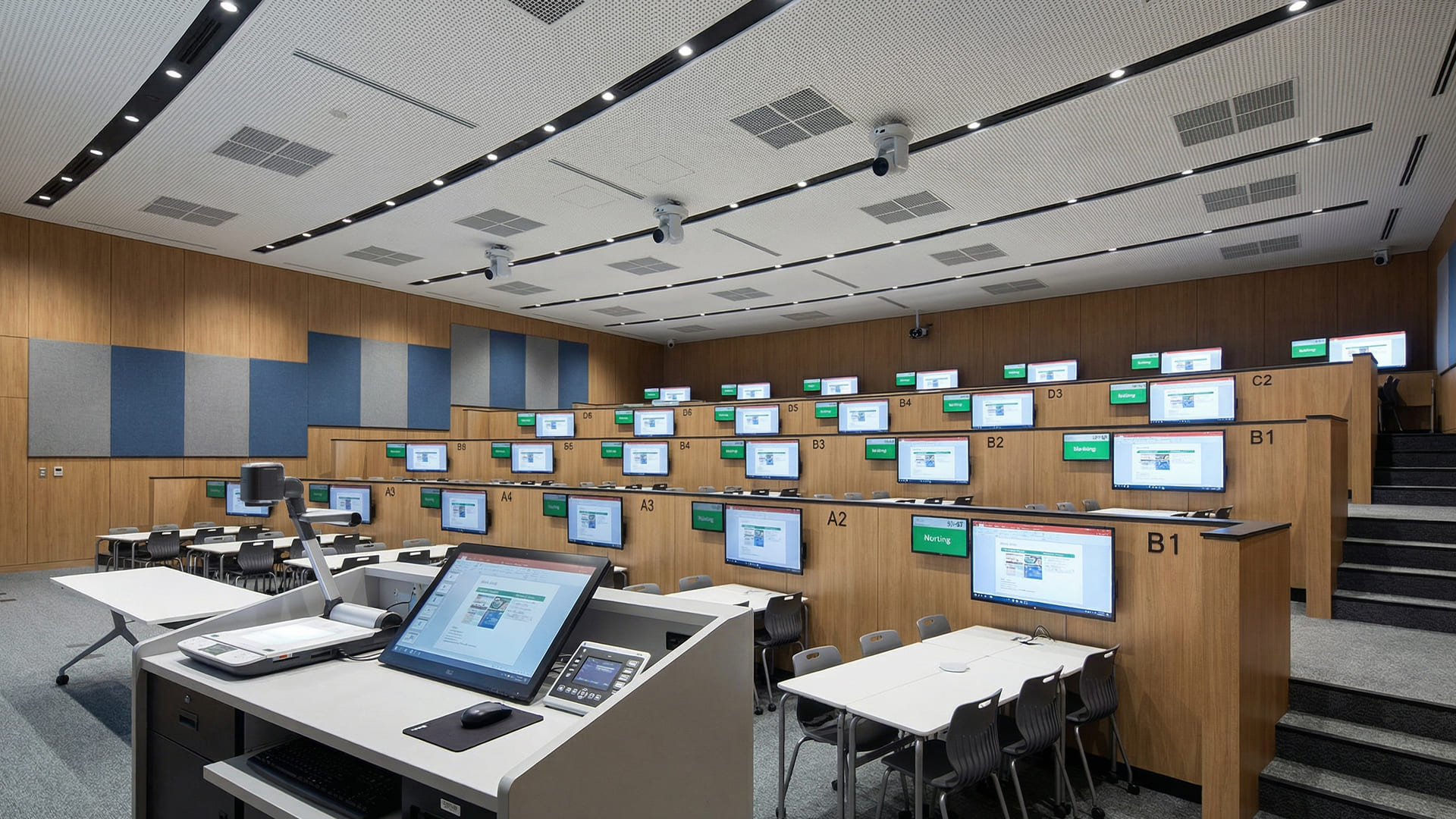
This requires a different approach to system design. Active learning environments need flexibility above all else. Multiple displays positioned strategically around the room ensure 360-degree visibility. Wireless collaboration systems that let students share content instantly from any device eliminate friction and encourage spontaneous participation. Intelligent audio systems with beamforming technology and ceiling arrays ensure that group discussions remain clear and that remote participants feel truly present.
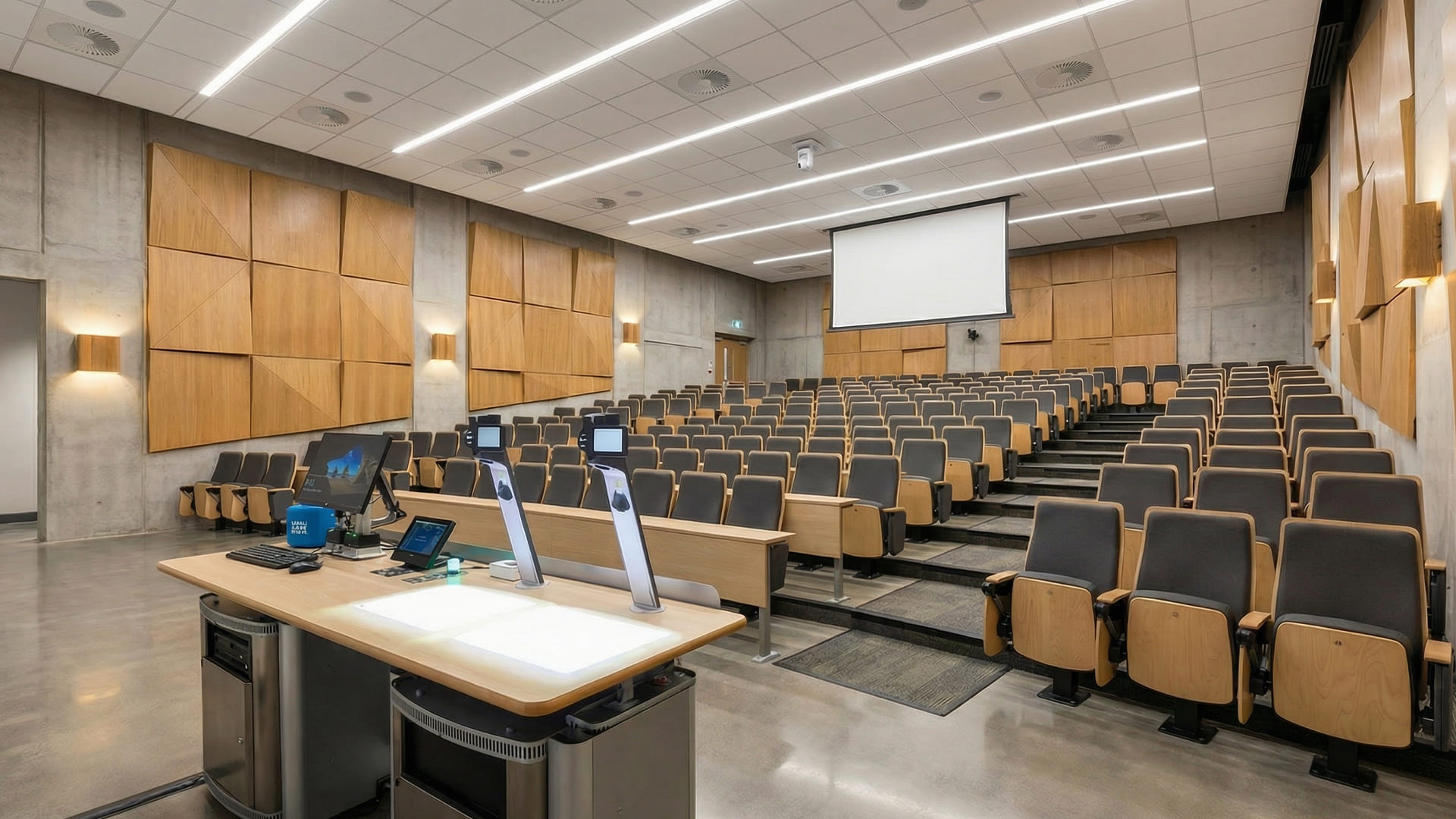
Visualizers and document cameras, once considered basic teaching tools, are finding renewed relevance in this context. They bridge the gap between physical and digital, allowing teachers to demonstrate real-world objects, work through problems on paper, and show detailed processes in ways that purely digital content cannot match. When integrated properly into lecture capture systems, they become powerful tools for creating reusable learning content.
The hybrid learning boom has expanded the scope even further. Schools need PTZ cameras that can follow the action in a classroom, tracking whoever is speaking. They need cloud-connected systems that make recording and distribution seamless. They need control systems simple enough that any teacher can manage them without technical support. The institutions getting this right are creating learning experiences that work equally well whether students are in the room or joining remotely from across the country.
For AV companies, success in this market requires more than technical expertise. It requires collaboration with architects to design spaces that support mobility and group work. It requires understanding how educators think and what challenges they face daily. It requires creating solutions that are robust enough to handle the demands of busy classrooms but intuitive enough that teachers focus on teaching, not troubleshooting technology.
The Indian AV industry, with its mix of local integrators who understand regional contexts and global solution providers bringing cutting-edge technology—is uniquely positioned to lead this transformation. Companies that invest in understanding active learning pedagogy, that build relationships with educational institutions, and that can deliver integrated ecosystems rather than disconnected products will find themselves at the center of a movement that’s reshaping how an entire generation learns.
Beyond Hardware
The opportunity extends beyond hardware into software and analytics. Modern AV systems are becoming intelligent ecosystems that can track participation levels, measure acoustic performance, and analyze how students interact with content. For institutions, this data offers insights into how learning spaces actually perform, which layouts work best, when students are most engaged, where technical issues create barriers.
For AV providers, this opens new revenue streams around analytics platforms, ongoing optimization services, and data-driven space design. Schools that invest in active learning infrastructure want to know it’s working. They want metrics showing that their investment is translating into better outcomes. Companies that can provide this visibility, that can help institutions continuously improve their learning environments based on real data, create lasting partnerships that go far beyond one-time installations.
The Future is Active
At its heart, active learning is about respect, respect for students as capable thinkers, respect for the complexity of real understanding, and respect for the fact that learning is an active process, not a passive reception of facts. The classroom of the future won’t have neat rows of silent students. It will be messier, louder, more unpredictable. It will also be more human, more engaging, and more effective.
Technology plays a crucial role, but it’s just the enabler. The real transformation is in mindset, recognizing that the teacher’s job isn’t to be the sage on the stage but the guide on the side, and that students learn best when they’re challenged, supported, and given space to explore. As one educator put it, active learning isn’t about replacing the teacher. It’s about amplifying engagement through experience.
India has the policy framework, the technological infrastructure, and the educators to make this shift. What’s needed now is commitment, to train teachers, to invest in learning environments, to redesign assessments, and to trust that students, when given the chance, will rise to the challenge of being active learners. The schools that embrace this transformation won’t just be preparing students for exams. They’ll be preparing them for life.