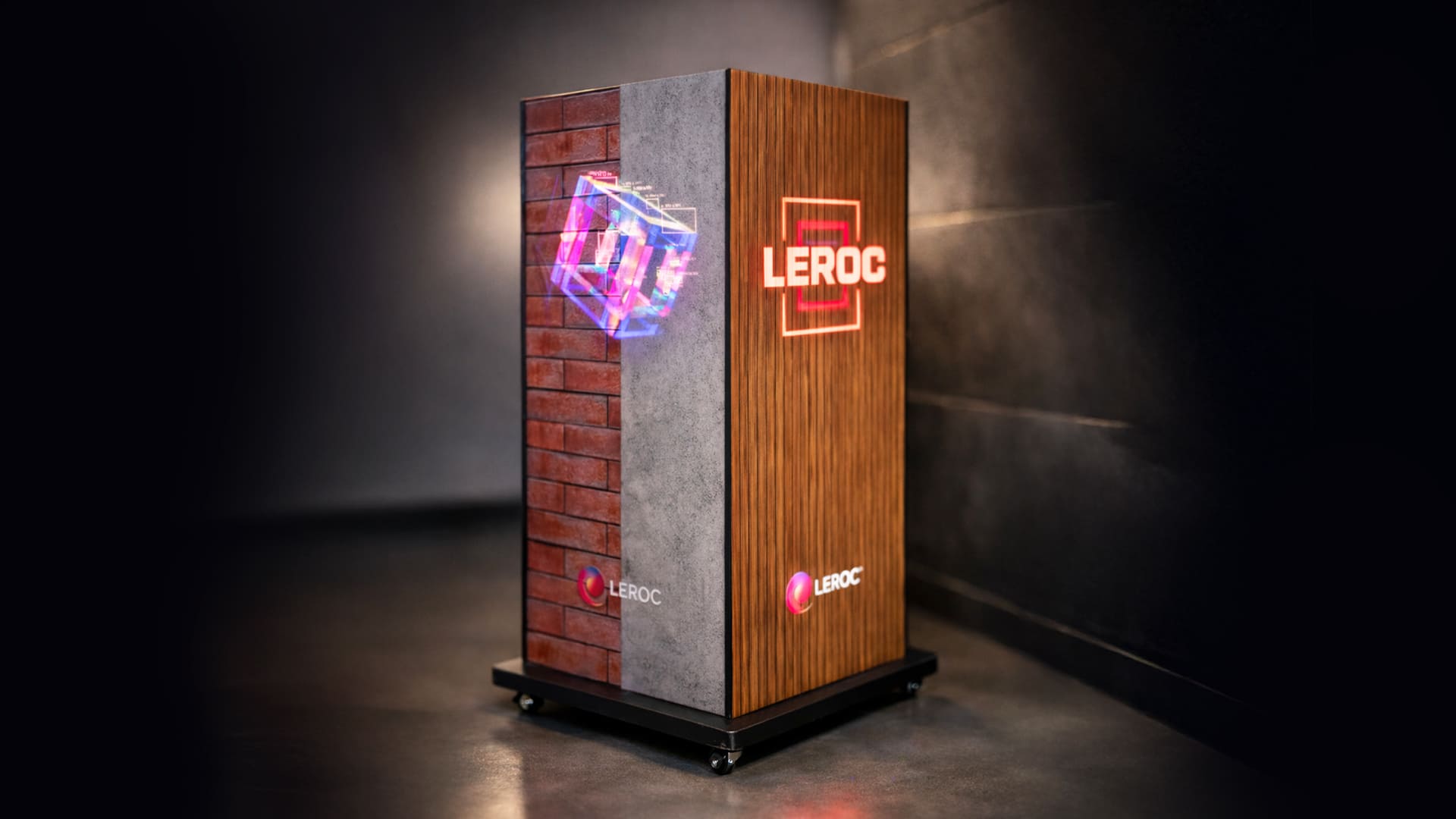
There is a moment, inside an experience centre in Bengaluru, where the visitors are waiting for the elevator and suddenly, they are greeted with a display message that appears on the wooden panel, taking them with surprise. No frames, no bezel, no edges, the messages appear from nowhere and the wall comes alive. A display blooms from within the wood grain, content flowing across a surface that gave no indication it was anything other than architecture. This is Bose George’s benchmark. For the Managing Director of Leroc CX Tech Limited, the most powerful technology is the kind you do not notice until it is already telling a story. “If someone asks where the display is,” he says simply, “we have done our job.” That invisibility, it turns out, is very much by design.
Bose started Leroc in 1997 with marketing collateral, print communication and exhibition graphics for India’s nascent IT industry. Those early years gave him something most AV professionals never develop, a material-level understanding of how physical objects communicate meaning.
“We were designing ads for companies like Mercury and Dataquest,” he recalls. “Then we got our first booth, for Interface at IT.com. We worked through the night, handed it over, went home. I woke up to a call saying we’d won the best stall award and made a quarter page in the Economic Times. That was our beginning.” From that first booth, Bose identified a structural problem, designers could imagine, but vendors could not build. Innovation was consistently surrendered at the supplier’s door.
So, he chose the harder path, building capability instead of outsourcing it. One large-format printing machine became a CNC router, then a laser cutter, then a metal fabrication unit. The production arm, now called Printree, grew for years at a loss before becoming the production hub of everything Leroc does today. “For five to six years, Printree was a major loss,” he says without flinching. “But we kept going because we knew control was everything. Control of quality, control of timelines, control of what we could promise a client.” “Give us the problem statement and we will give you the solution. That is our commitment.”
A Patent in the Making
If there is one innovation that defines Leroc’s market position, it is the invisible display, a technology the company spent nearly ten months
perfecting and is currently patenting.
The origin was a radical client brief, a display that does not look like a display. No rectangular black screen. No visible edges. The surface had
to remain visually intact, until content appeared. What followed was months of experimentation, materials tested and discarded, prototypes failed, optical treatments refined. “We did it, then there were glitches, we went back to the drawing board,” Bose explains. “Each time there were problems to address. Finally, we refined it to something commercially viable.”
The result, powered display technology embedded directly into architectural surfaces. Wood, cement, marble, the cosmetic treatment mirrors
the existing finish so precisely the display is undetectable until it activates. Every installation is bespoke, engineered to the specific conditions
of each site. “In Wipro’s case, they already had a panel. We treated their existing material, figured out the finishes, and gave it that exact finish as a final product.”
Applications are expanding. Leroc is currently building conference table with an invisible display, an ordinary-looking surface from which content will emerge mid-meeting. Bose is also developing interactive versions with touch response.
Storytelling at Scale
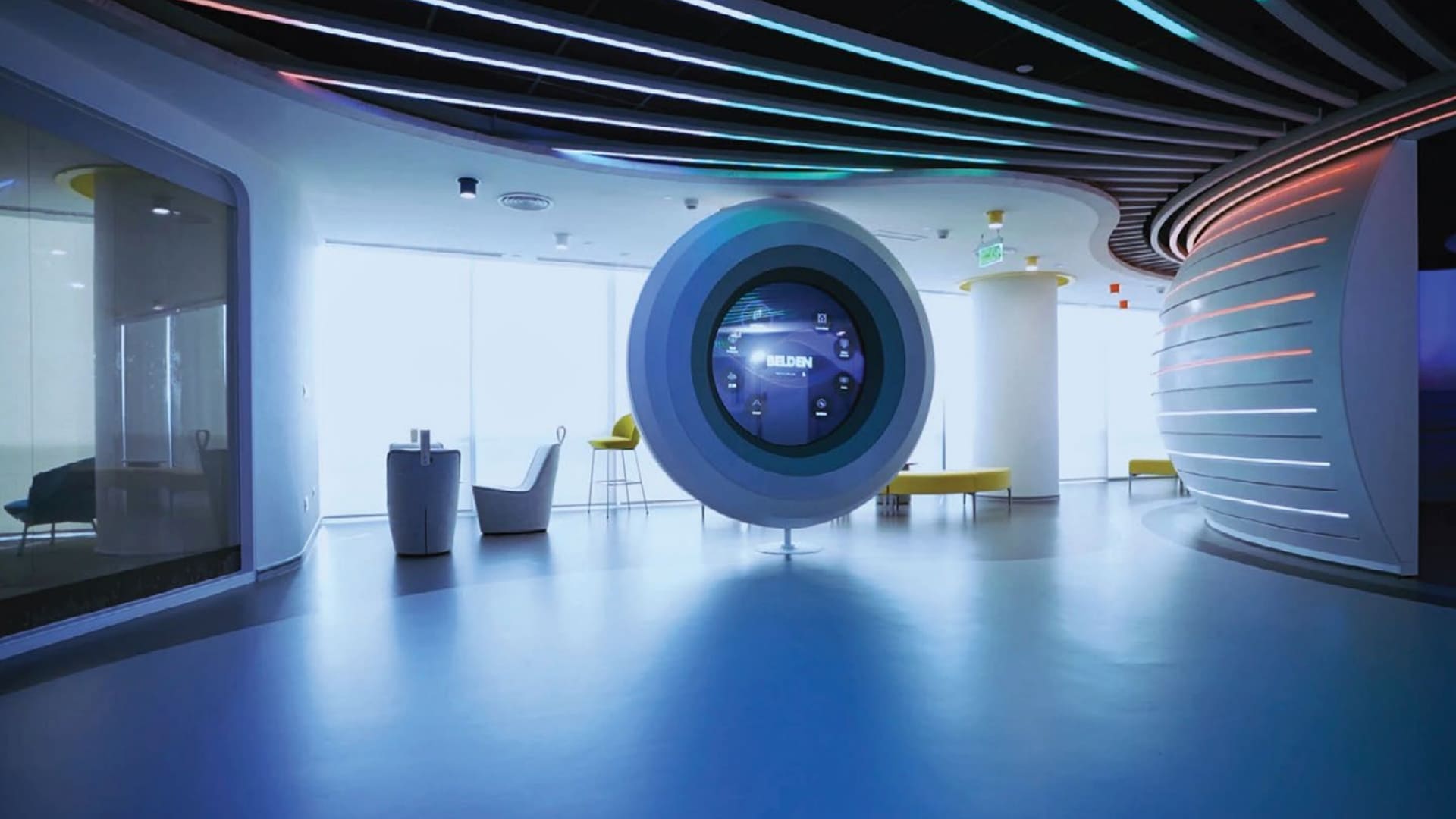
The Belden experience centre in Bengaluru, completed two years ago and still operating without significant maintenance, is the most comprehensive illustration of Leroc’s design philosophy in action. Flexible displays were embedded into moss walls with such precision that they appear, at first glance, to be film draped over organic material. A transparent LED wall, one of the largest of its kind, curves across glass manufactured specifically for the radius of that room. A central Display installation rotates 360 degrees, its audio concealed behind a fabric ring that camouflages speaker cut-outs within the structure’s design language. Tables carry wireless charging built into the surface. Lighting is occupancy aware. Even acoustic panels double as brand elements, the Belden logo itself constructed from sound-dampening material.
“The experience centre is not about displays,” Bose says. “It is about how effectively you tell your story to your customer. Everything else, the transparent screen, the rotating structure, the moss wall, those are tools. The story is what matters.”
He is frank about conventional approaches: “If it is told on a PowerPoint, it is absolutely not effective. You need to show it in real life, larger
than life. Then the client takes you that much more seriously.”
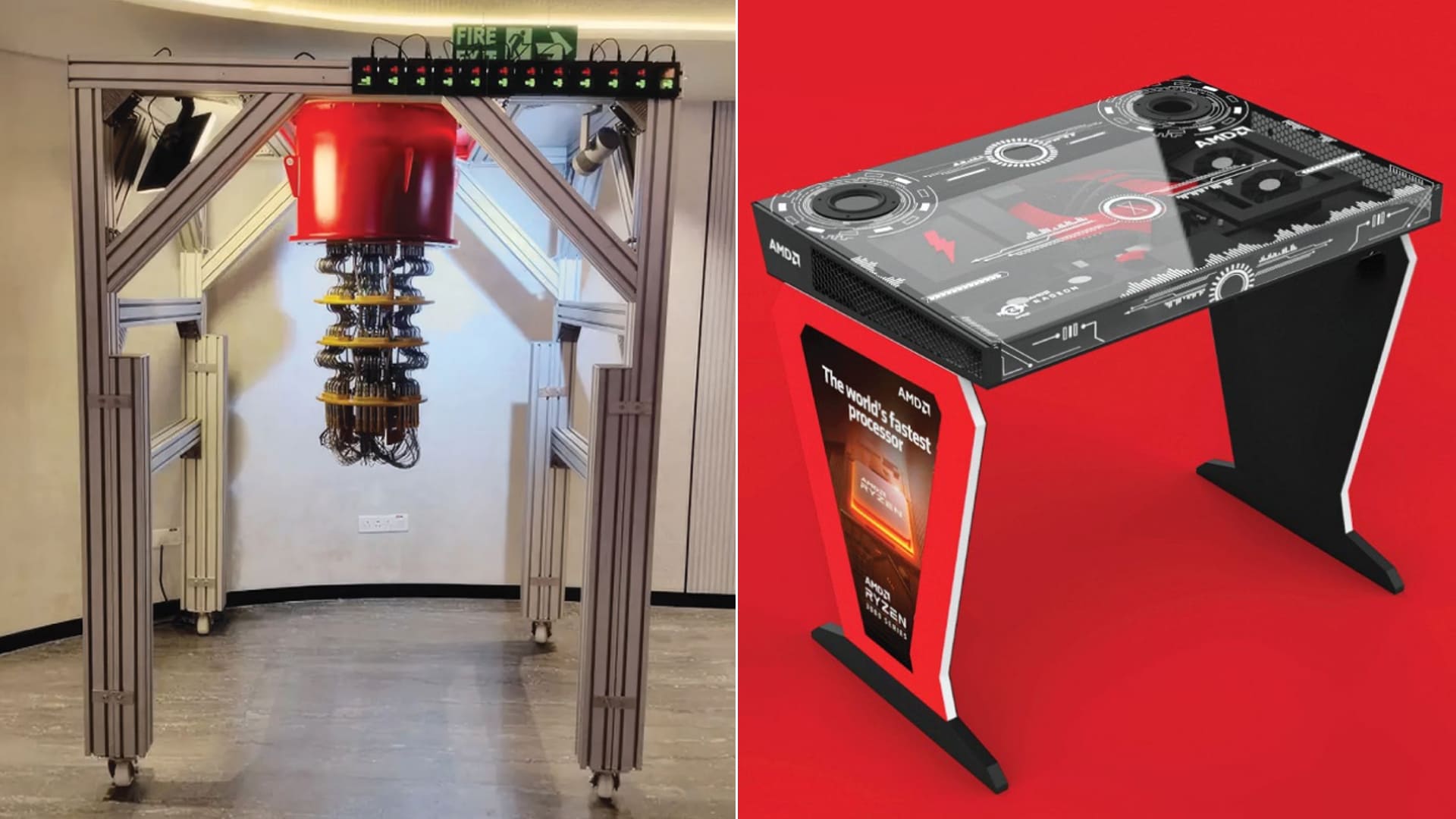
How do you explain quantum computing to a non-technical audience? Leroc built the machine. Working from reference imagery alone, no blueprints, no schematics, the team fabricated a full-scale replica with nearly 3,000 individually developed components. Liquid cooling tubes, structural geometries and proportions were reconstructed with dimensional accuracy from photographs.
“We did it in about six to seven days,” Bose says. “The client gave us an image. We recreated everything from that to the measurements, to everything.” Non-functional, but profoundly convincing, the replica transforms an abstract concept into something visitors can walk around and emotionally register. Physical presence creates memory in ways that screens rarely do. The installation subsequently drew sustained attention at a major technology summit, from audiences who might otherwise have skimmed past an animated explainer.
India AI Summit
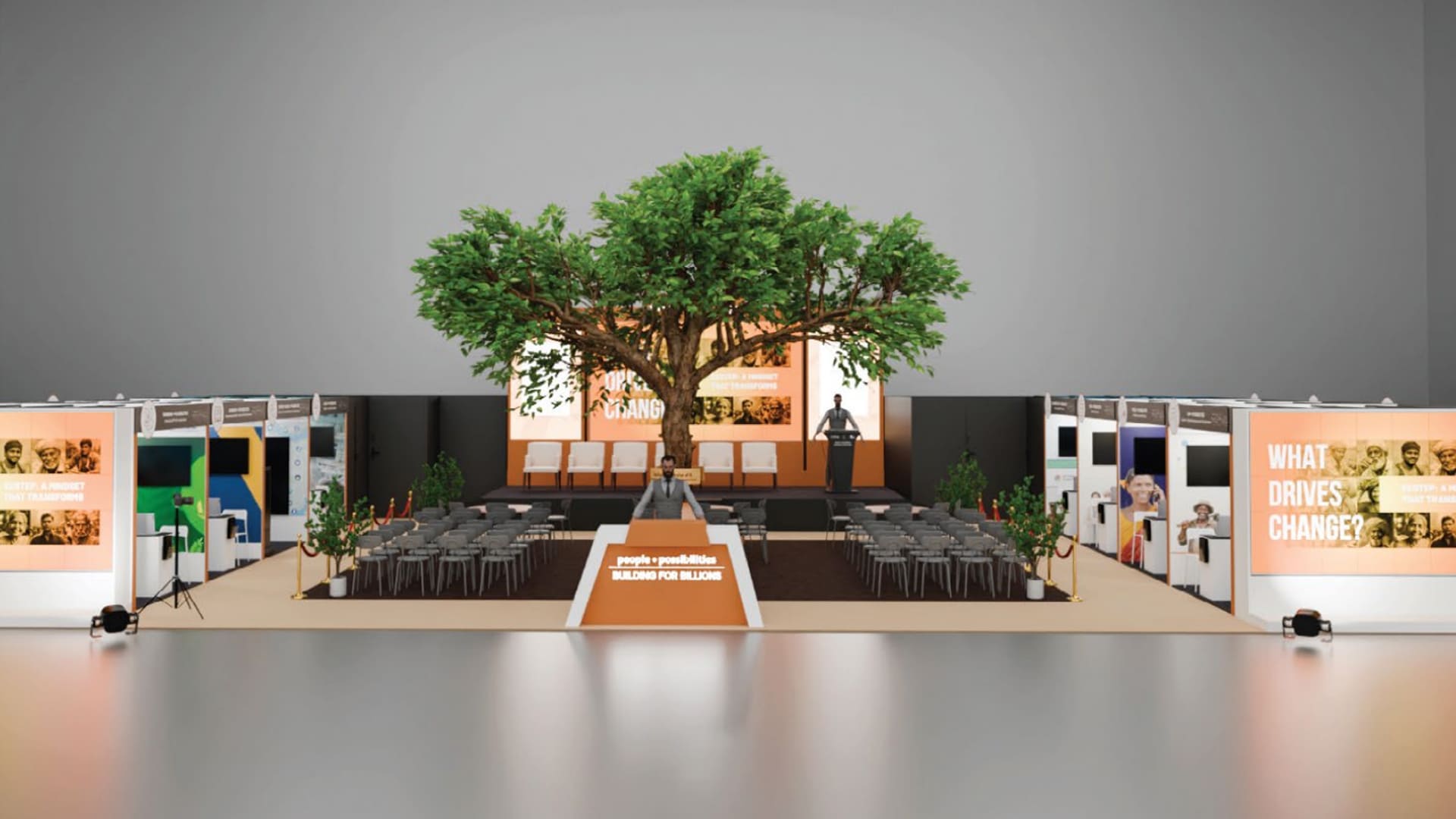
The India AI Summit showcased Leroc operating at national scale under brutal timelines. For AMD, the team designed and fabricated an entirely cantilevered booth, structurally large enough for people to sit and work inside. Lighting responded dynamically to presentations, changing colour based on the client being addressed. The entire booth, from brief to installation in Delhi, was completed in fifteen days, with roughly seven allocated to manufacturing. “The client came to us at the last moment,” Bose says. “Nobody slept much. but nobody complained”. for another client at the same summit, Leroc built a Kalpavriksha, a wishing tree representing AI as a modern fulfilment of ancient aspiration. The gaming rigs, Leroc has developed, transparent, fully functional computers designed as tables, with integrated thermal management and acoustic dampening, represent another expression of this philosophy. Over 200 units have been deployed across gaming zones and experience centres nationwide. “Innovation is not about inventing new technologies. It is about finding creative ways to use what already exists.”
The Build Advantage
Leroc’s manufacturing muscle runs deep. From CNC machining and laser cutting to flexible display integration and custom electronics, everything is built under one roof in Bengaluru, and that self-sufficiency is the quiet engine behind every commitment the company makes to a client. “Most competitors promise the earth, the sun, the moon,” Bose says. “Then the vendor says the stock isn’t available. We have dependencies too, LED modules still come from China. But control is in our hands. And that’s everything.” That control extends to people and partnerships. A 120-strong team spans design, engineering, production, events and digital. Client relationships are long and deliberately few, some stretching two decades or more. Not a single outstanding receivable on the books.
Going Global
Leroc’s current financial year is expected to close at ₹100 crore, up from ₹83 crore the previous year, when the company transitioned to limited status. An IPO is on the horizon, with a clear global mandate, Europe, the Middle East and Singapore.
Before the global chapter can fully open, Bose must solve a more grounded problem: the company has outgrown its space. “There is a limit to how much we can deliver right now,” he says. “The biggest limitation we have is space.” A larger facility and a dedicated factory are both in the pipeline, investments that will give Leroc the capacity to pursue international projects at the scale they demand. Europe, the Middle East and Singapore are already in the crosshairs for post-IPO expansion, with the region holding promise as a market where innovation-led design finds its most receptive audience.
Meanwhile, Bose keeps one eye firmly on the horizon. Leroc is actively researching holographic display platforms and exploring what interactive invisible displays might look like across an entire wall or ceiling, touch-responsive, immersive, seamless. These are not distant ambitions. They are active research threads. “We are doing our own research,” he says. “We will get there.”
Built on Belief
Ask Bose what business Leroc is in, and the answer shifts depending on the project experience design, fabrication, AV integration, spatial storytelling. But the thread that runs beneath all of it is simpler, belief. Belief that a surface can hold more than it shows. Belief that technology serves best when it is the least visible. Belief that India has a creative voice worth hearing on the world stage.
“We are at least finding creative ways of using whatever is already there,” he says. “Things like the invisible display are taking us a long way.” It is a characteristically modest way of describing what is, in fact, a significant act of original thinking.
He wishes the environment around innovation were more forgiving. Institutional support, he feels, remains thin for those willing to take creative risks. But Leroc has never waited for permission. It has grown quietly, selectively, on its own terms – and the world, slowly, is noticing.