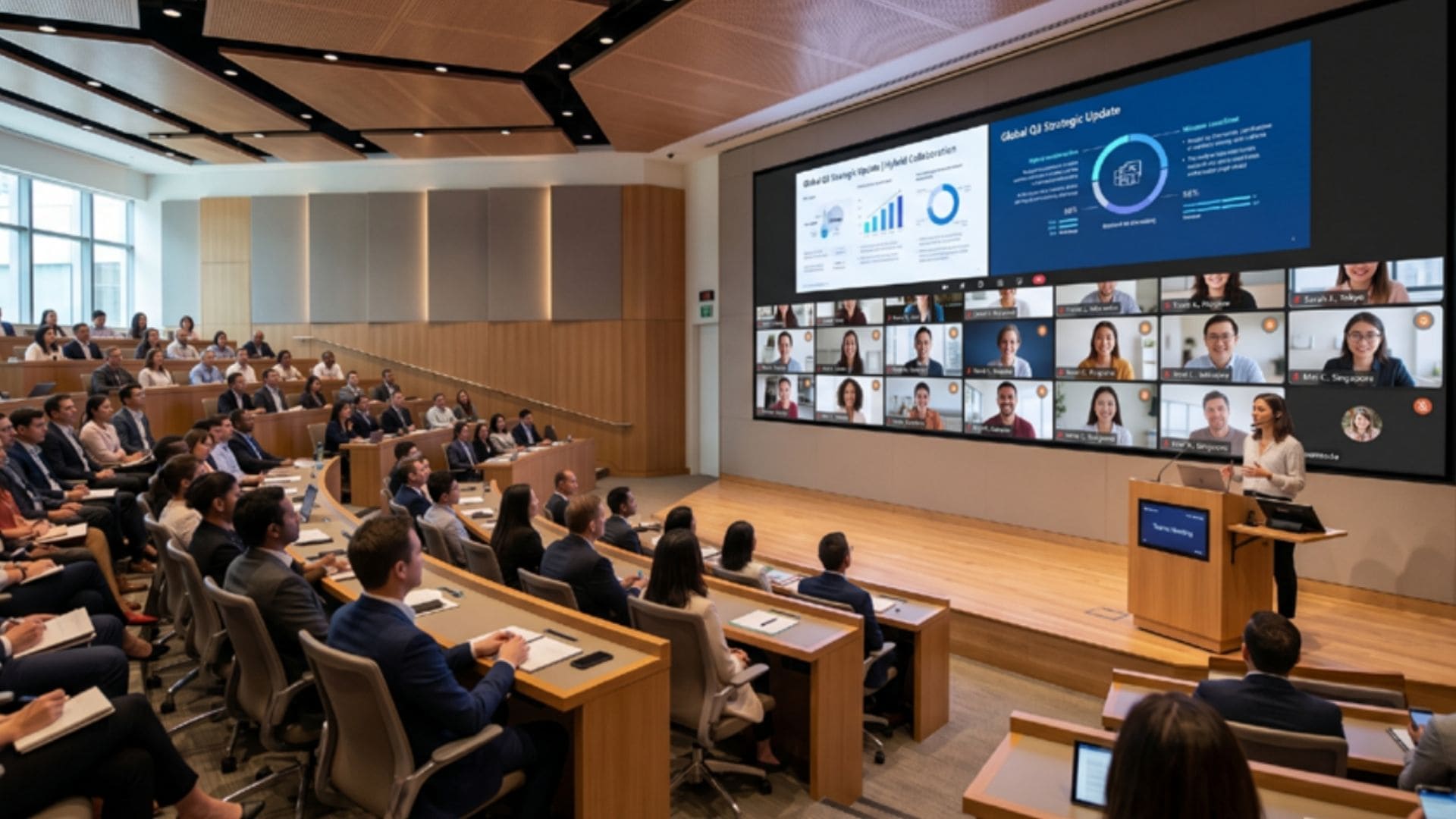
The term ‘smart classroom’ is currently employed so ubiquitously that it risks becoming devoid of its original significance. Upon entering any recently renovated facility on an Indian university campus, one is likely to encounter an interactive flat panel, an IP camera, and a room-control panel, with someone proudly referring to it as a smart room. However, for AV consultants and integrators engaged in delivering medium to large-scale projects for prestigious educational institutions, the distinction between a room equipped with costly hardware and a genuinely intelligent learning environment is not merely semantic. It delineates the difference between a client who commissions you for the next building and one who quietly discontinues the engagement.
Because this is one of the largest L2 installations anywhere in the world, L-Acoustics sent Joshua Maichele (Global Applications Lead for Houses of Worship, L-Acoustics), their specialist, on five flights from the United States to Chennai to personally oversee the final calibration in March. That level of commitment from the manufacturer speaks volumes about the project’s scale and significance.
India’s educational technology market is currently at a remarkable inflection point. According to IMARC Group, the Indian EdTech market, valued at USD 3.63 billion in 2025, is projected to reach USD 33.31 billion by 2034, exhibiting a compound annual growth rate of nearly 28%. The India Brand Equity Foundation estimates the broader edtech sector to be worth Rs. 2,50,850 crore (approximately USD 29–30 billion) by 2030–31. Concurrently, India possesses a population of 580 million individuals aged 5–24 years, representing the largest youth educational demographic globally. This constitutes a fundamental shift in how premium institutions perceive technology investments: not as a deferred expense but as a strategic imperative for maintaining institutional relevance and
enhancing student outcomes.
The hardware trap
The most prevalent mode of failure in premium educational AV projects is the hardware trap: evaluating quality based on the specification sheet rather than on learning outcomes. An impressive 4K interactive flat panel, a Dante audio matrix, and a bespoke room-control graphical user interface are notable; however, they become entirely irrelevant if faculty members are unable to operate them reliably or if remote students are unable to hear the presenter effectively. Since 2020, India’s classrooms have experienced a surge in technological investment; nonetheless, a recurring pattern has emerged: institutions tend to procure hardware in response to ranking pressures or announcements by competitors, leading to the acquisition of costly equipment that remains underutilized.
Faculty readiness continues to be a well-documented challenge. The DEIFDC index, which monitors digital education infrastructure across Indian institutions, rates the country at 0.596, identifying infrastructure deficiencies and pedagogical limitations as primary impediments. Research indicates that faculty unpreparedness is a principal constraint on digital education outcomes, alongside issues related to connectivity and device affordability.
For systems integrators, this data functions as a guiding design brief. The critical question is how to guarantee that technology functions reliably when used by a lecturer who has only twelve minutes between classes and minimal tolerance for troubleshooting. In environments where institutional patience for downtime is low, designing for reliability becomes the most pivotal decision.
Intelligence is in the architecture
A smart classroom’s effectiveness relies on its integrated architecture. AVoIP has become essential for large-scale deployments, as it simplifies scaling and management compared to traditional point-to-point AV systems. For multi-building campuses in India, unified management is crucial. Success with AVoIP depends on a robust data network. While top institutions invest in campus networking, AV teams are often not involved in planning. The best integrators work early with IT, specify QoS and bandwidth needs, and include network upgrades in project plans before purchasing displays.
Hybrid is not a mode; It is the default
Design for hybrid first must govern every premium education AV project in 2026. India’s higher education system has been permanently reshaped by policy direction. The NEP 2020 aims to increase the Gross Enrolment Ratio to 50% by 2035, emphasizing blended and online learning. Platforms like SWAYAM and DIKSHA 2.0 indicate hybrid delivery as the permanent model.
AV integrators should move beyond optimizing lecture halls for local audiences alone. Baseline specs now include AI auto-tracking cameras, beam-forming microphones, and echo cancellation. With over 900 million active internet users in 2025 and rural broadband expanding, remote learners from Tier 2 and Tier 3 cities form a significant part of enrollments. Integrators must plan for low-bandwidth fallback and focus on high-quality audio to ensure hybrid access.
AI: Practical today, transformative tomorrow
AI has moved decisively beyond marketing buzzwords to deliver measurable value. The most immediately actionable AI applications are at the device level: auto-framing cameras that track presenters, intelligent audio systems that isolate speech, and room analytics platforms that capture occupancy and technology usage patterns. This data is vital in the Indian context. Institutions competing for NAAC accreditation, NBA certification, or positions in the NIRF rankings face growing pressure to demonstrate that infrastructure investments translate into learning outcomes. Aggregated room analytics data presented in a dashboard provides facilities leadership and academic administration with compelling proof of utilization. DIKSHA 2.0’s launch and UNICEF India’s December 2024 consultation on generative AI and AR/VR point to a future where the classroom functions as a data-generating environment. Integrators who design data architecture into their projects now, while respecting India’s Personal Data Protection framework, will hold a substantial competitive edge.
What premium institutions truly seek
Premium education clients ultimately seek confidence that technology will work every time a faculty member walks into a room, that investments will not become obsolete before the next NAAC cycle, and that a knowledgeable partner will respond immediately when issues arise. Consequently, the integrator’s role has expanded from vendor to strategic partner, bringing insights into pedagogy, utilization data, and service continuity.
Campus-wide standardization is another critical requirement. Institutions with legacy systems and mixed procurement histories want a consistent, recognizable user experience from small tutorial rooms to 500-seat auditoriums. Standardization reduces faculty training overhead, simplifies support for stretched IT teams, and creates the conditions for genuine scalability while securing predictable managed services revenue for the integrator.
The integrator’s checklist for smarter projects
To create a successful AVoIP implementation, prioritize design for reliability with simplified switching, intuitive room control, and high acoustic performance to address common issues like reverberance and HVAC noise. Engage IT early by clearly documenting Quality of Service (QoS) and bandwidth requirements and obtaining written commitments to ensure project success. Ensure hybrid equity by providing remote participants a functionally equivalent experience to in-person attendees, recognizing Tier 2/3 remote learners as essential users. Embed room analytics to support institutional documentation requirements for NAAC, NBA, and NIRF. Lead with managed services by offering long-term agreements to foster durable client relationships instead of treating projects transactionally. Lastly, drive campus standardization by implementing consistent user interfaces across all learning spaces to reduce training overhead and streamline institutional support.
Conclusion: Intelligence is earned, not installed
India’s smart classroom market is a major global opportunity, driven by a large youth population, government initiatives like PM eVidya and NEP 2020, and private sector interest. Competition will highlight the difference between those who provide just specifications and those who deliver real outcomes. Truly smart classrooms require thoughtful design, reliable performance, continuous service, and a focus on measuring learning outcomes. With the market reaching USD 33 billion by 2034, integrators offering true value will shape future education.