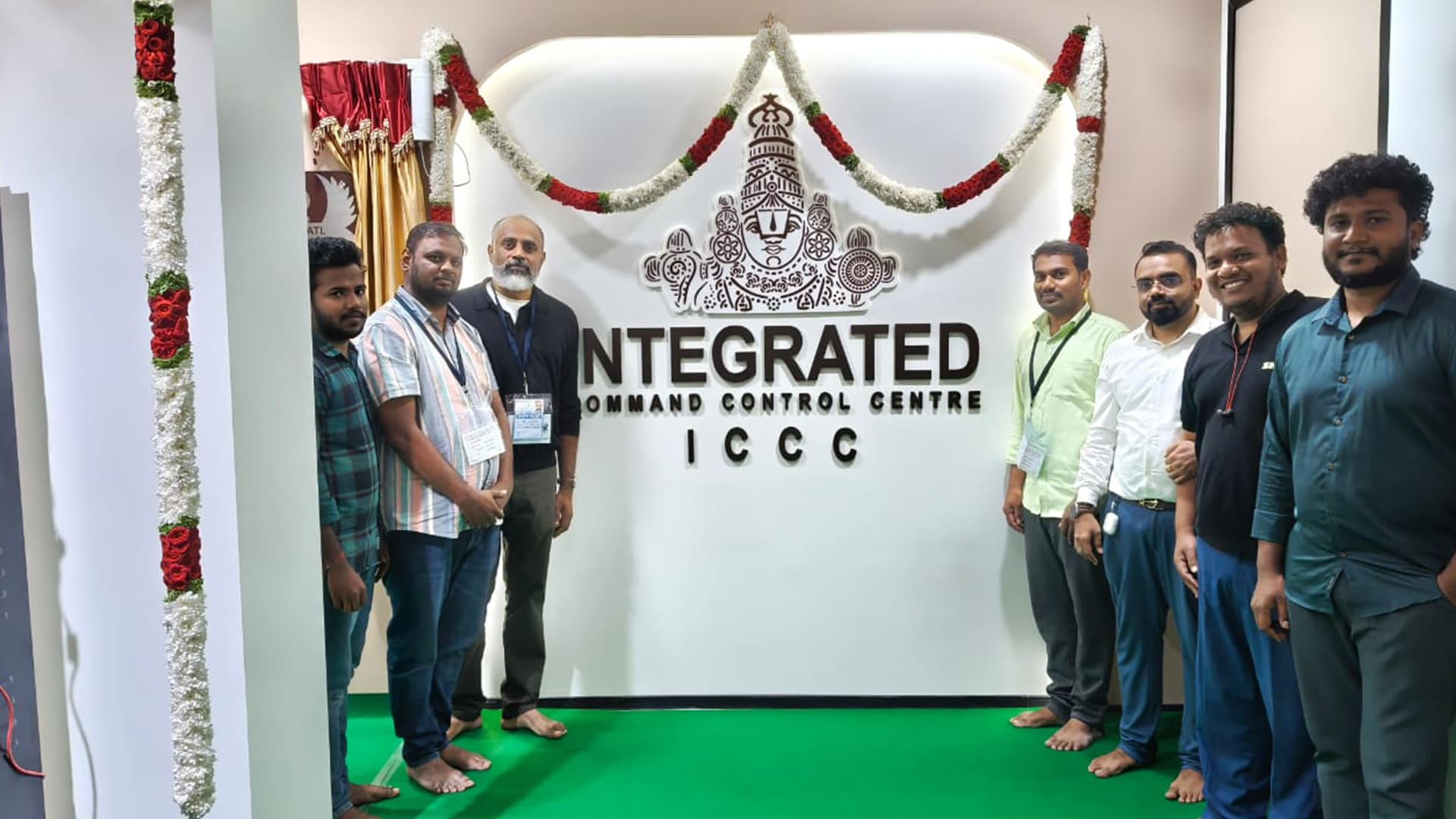
Every day, thousands of devotees visit the temple of Lord Venkateswara in Tirumala, which sits atop the Seshachalam Hills, also called the Seven Hills. In September this year, the Tirumala Tirupati Devasthanams (TTD) launched an Integrated Command & Control centre (ICCC) at the Vaikuntham Queue Complex, located at the heart of the temple complex.
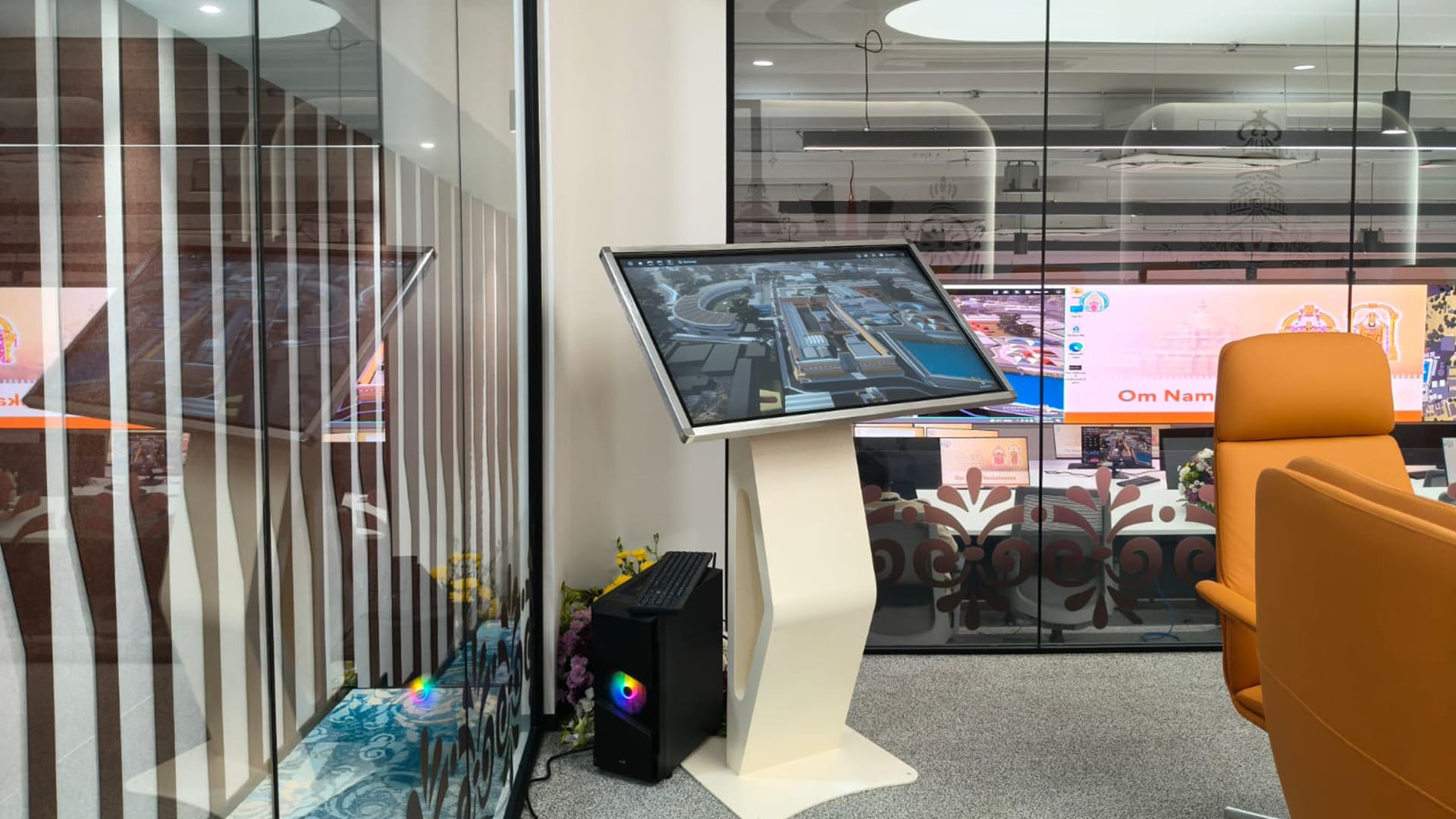
Designed to deliver real-time crowd prediction, safety, and cyber resilience across Tirumala, the ICCC consolidates live video feeds, 3D digital twin maps, predictive analytics, and cyber-surveillance for crowd management, safety, and pilgrim experience. AVFx Solutions Pvt. Ltd. was tasked with designing and delivering AV systems for this project. In collaboration with technology partners like Kloudspot and NVIDIA, the team delivered an innovative solution that has set a global benchmark for template ecosystems and seamless experiences for pilgrims.
Fostering divine connections
Being one of the most visited pilgrimage sites in the world, the Sri Venkateswara Swamy Temple in Tirupati sees daily pilgrim footfalls of between 50,000 and 1,000,000 devotees. Pramod DP, Managing Director at AVFx Solutions Pvt. Ltd., explains that the main goal was to increase the time worshipers get to spend with the deity from about 1 – 3 seconds to ideally about 30 seconds. “Because of improper crowd management, people were not getting enough time for darshan, even after waiting for one full day in the queue; some were being pushed because of a lack of crowd management. So, the whole idea was to increase the time to a maximum of 30 seconds for each worshiper, and that’s been made possible with proper crowd management.”
Elevating every step of the pilgrim journey
With features like real-time crowd prediction, 3D congestion visualization, and cyber threat monitoring, the ICCC plays a crucial role in enhancing every step of the worshippers’ journey through the temple complex.
To monitor the crowds, previously, the temple complex used a CCTV-based video system, with cameras installed across various locations. Pramod elaborates: “The complex had around 6000 cameras everywhere connected to the video management system, so there was a lot of data, but it was not being fully utilized to extract any analytics. Today, these cameras and the entire video management system are powered by Kloudspot’s AI models, ensuring smooth and efficient management of real-time crowd analytics and insights, which enable the operations team to make quick decisions and maintain control.”. Essentially, the ICCC acts as a central hub providing key insights from the Kloudspot Location Intelligence and Situational Awareness (LISA) platform to multiple departments, including vigilance, police, the Darshan, and the landside team.
Pramod shares a few real-world scenarios. “Based on live location data, the crowd management dashboard creates a heat map indicating crowd density. A red heat map indicates too much crowd, while yellow or orange signifies a moderate level, and green signifies a manageable situation,” he says. The cameras across the complex stream live footage with advanced features, such as face detection and recognition. The system also allows the team to instruct the security guards about which direction the crowd is moving in. “For example, if someone is identified as a potential troublemaker, they can be tracked as they move, and their path can be monitored,” he adds.
A state-of-the-art monitoring hub
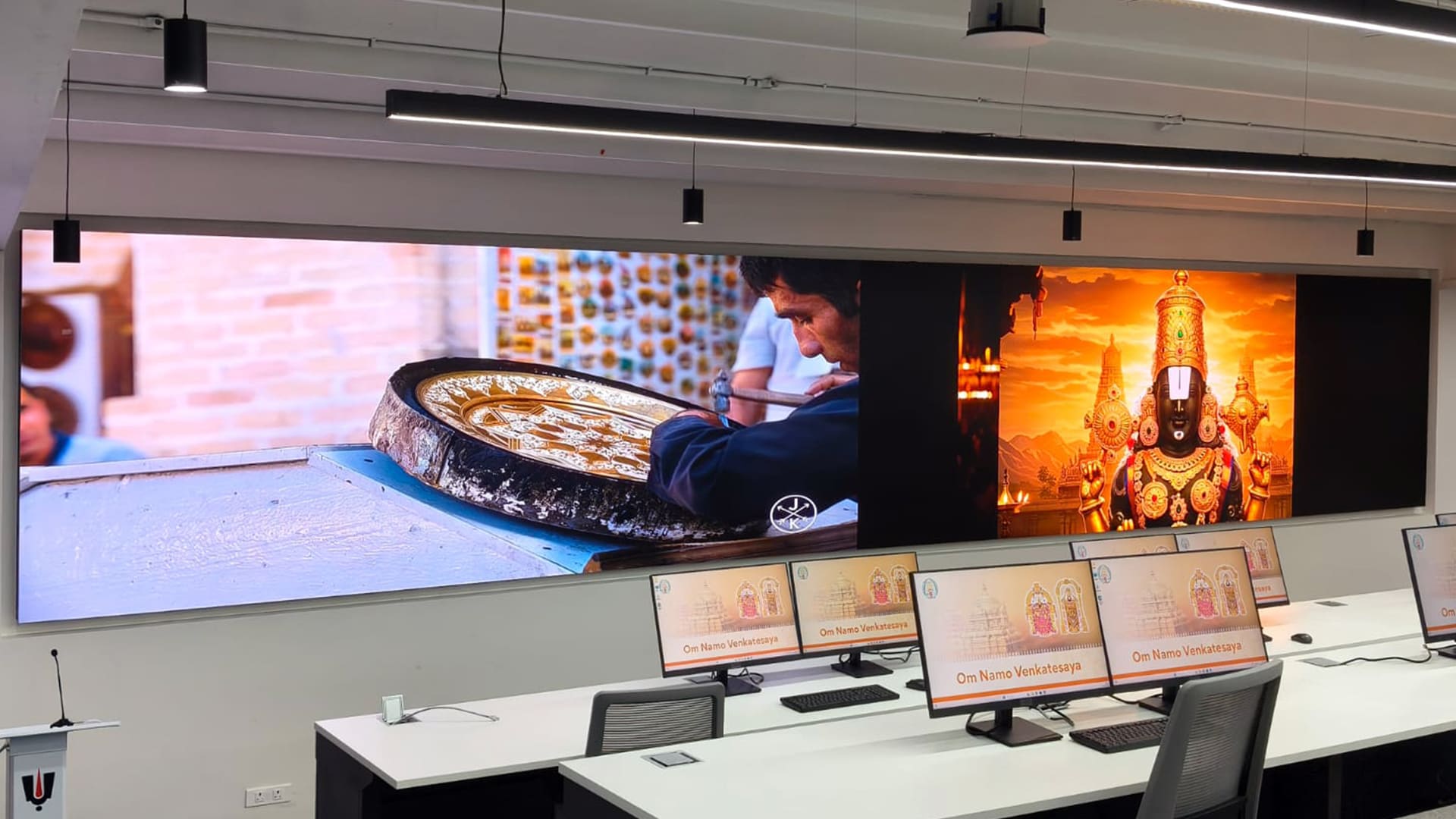
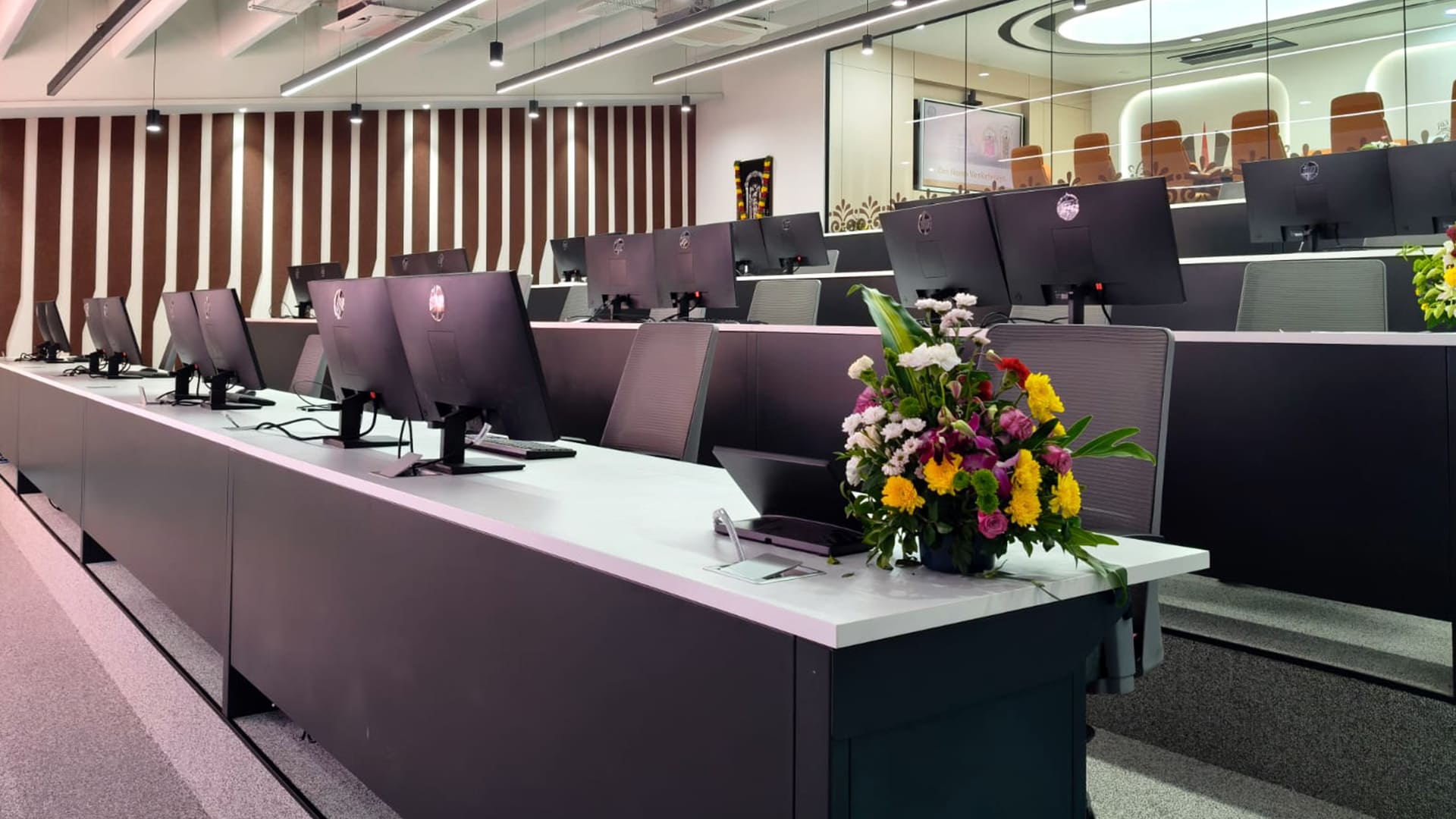
The centerpiece of the command center is a Samsung Wall Series IWC Indoor LED P1.2 video wall, running 419″ diagonally, with a resolution of 8320 x 1440 and a brightness of 1000 nits. The facility also features 60 Samsung IPS Panel Gaming 24″ monitors that assist teams in monitoring critical dashboards in real-time. A 49″ Odyssey OLED G9 monitor is placed in the server room.
“The client wanted a large LED display, so we connected around 65 to 70 modules in total, which are stacked together to create a cohesive video wall,” explains Pramod. The choice of Samsung as the preferred brand was driven by its strong reputation in the market. He also highlights Samsung’s micro LED solution and blue cut technology, which reduces blue light emissions, thereby preventing eye strain. “It also has Black Seal Technology+, which adds to the reliability factor,” he adds.
Pramod points out that the Blackbox Windows-based ST-VWP-200 Series video wall processor is central to the functionality of the command center. “Even though there are multiple modules in Samsung, all these modules are connected to Samsung S-boxes. In total, there are three S-boxes, each of which controls different screens. When the three screens need to be mapped as a single wall, the process is managed by the Blackbox video wall processor. The unit can take up to 16 inputs and provide four outputs, but we are only using three outputs as there are only three displays.”
One of the distinctive features of the system is the built-in redundancy for both power and network connections. “In case of a failure, the processor can automatically switch to a redundant power supply or network connection. This functionality ensures that the 24-hour application can continue running smoothly,” Pramod points out, while elaborating that the system will send alerts in the event of a power or network failure, giving operators enough time to respond, as a redundant port is available and functioning in parallel. The facility also hosts another command room that functions like a server room, where the team can monitor the video wall without entering the command centre; the Blackbox facilitates this monitoring capability as well.
Real-time collaboration
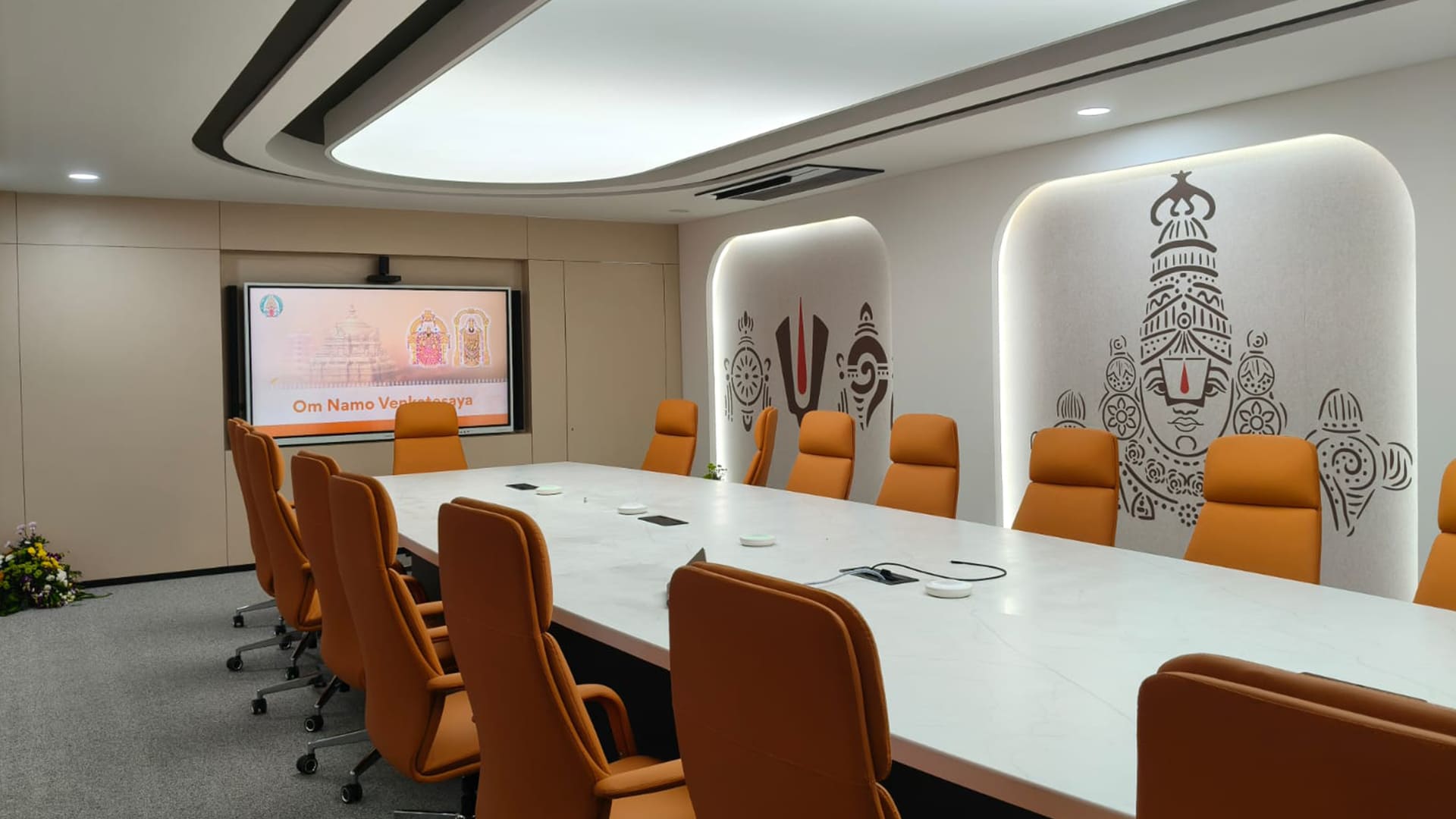
Strategically located next to the command centre, is the conference room, a space that is used for discussions, meetings, and critical decision-making during incidents. This space features a Samsung 85″ UHD 4K Touch Display, a Crestron Flex Advanced Video Conference System Integrator Kit for Zoom, and a Yealink UVC86 4K dual-eye tracking camera that ensures that participants can easily join discussions and are fully engaged. The audio experience is powered by five RM-TT Dante Wired Tabletop Array Microphones, and a RM-CR Remote Conference Processor equipped with Dante connectivity, and two Yamaha Dante PoE powered VXL1B-16P speakers to deliver crystal-clear sound throughout the room.
“Content displayed on the command centre’s main video wall can be easily shared on the meeting room screens, and remote teams, like the police or security personnel, can join Zoom calls, enabling two-way communication and screen sharing,” highlights Pramod, emphasizing how this fosters real-time collaboration and situational awareness.
Seamless audio
For audio, the command centre is equipped with four Crestron Saros SAROS IC6T-W-T 6.5″ 2-way in-ceiling speakers and a Yamaha XMV4140 4-channel amplifier complemented by an Erthpot PC1 Parameter Controller and an Erthpot KEYER 88D audio processing and control system. “We chose this audio solution because Yamaha has a package solution called Artesia, which bundles DSP speakers and table microphones, ensuring all our audio needs are addressed,” says Pramod.
Everything operates on a Dante PoE (Power over Ethernet) network, including the 16-column array speakers. Pramod highlights the simplicity of the installation, noting that “there is no external amplifier required. You just need a simple CAT 6 cable, and once you do the calibration, you’re all set. The audio quality was excellent; even the chief minister, who inaugurated the centre, was impressed with it.”
Pramod describes the control system. “The setup includes a Crestron 4-Series control system and several Lightware Torus boxes for automatic switching. We have two touch panels – one in the command center and the other in the conference room and have intentionally kept the interface as minimal as possible. Users can manually drag and drop video feeds to override the default settings and view a specific video.”
Racing against time
Speaking of challenges, Pramod points out that time was crucial in getting the project ready for the inauguration. He notes that the entire process, from design schematics to detailing plans for all stakeholders and getting final approvals, took about three months, and the actual execution and delivery of the project had to be completed within 15 days. Pramod elaborates: “Our team in Hyderabad traveled on-site and put in a tremendous amount of effort. We had to determine the power requirements, support needed from the backend to set up the displays, the cable routing, and other related tasks. But, thanks to the team who worked on two shifts, we completed the project in time for the inauguration, including civil work, interior design, networking, glass partitions, and everything.”
An innovative approach
When asked about the most unique feature of the ICCC, which is celebrated as India’s first AI-integrated pilgrimage command hub, Pramod emphasizes its crowd management solution.
“People are looking at this kind of space in a way nobody else has before,” he notes, adding that they already have experience in delivering occupancy intelligence solutions for the corporate sector, and this approach marks a shift in how crowd dynamics are monitored and managed in pilgrimage sites.
He underscores another stand-out feature of this solution: a 90% accuracy level, which is considered healthy for people tracking, and explains how this system was rigorously tested and put on demo before it was implemented: “It was thoroughly checked and then got approved as the clients wanted to verify its accuracy. Many claim to use AI, but accuracy matters, especially when counting people. So, everything is monitored live in real-time, ensuring that we maintain this 90% accuracy level.”
Unlocking possibilities
The ICCC project at Tirulama is a brilliant showcase of the integration of AI and advanced technologies into AV systems, signaling a transformative shift in the industry.
Reflecting on this shift, Pramod shares his perspective: “Earlier, it was purely AV; nobody was talking about integrating with building management systems or command centres like this. It was like: ‘the AV folks will come, hook up the displays or video walls, and show us what the content is going to be’. That’s all it was.”
By harnessing data from sensors and cameras, organizations can address common challenges, like meeting room no-shows, more effectively, he notes. “For example, we are capturing data on no-shows in meeting rooms. If someone books a meeting room for an hour but only uses it for half an hour or doesn’t use it at all, the room remains unbookable for others. Earlier, we lacked proper data, but now, with these sensors, we can release the room for booking if no one is present and also identify individuals accountable for these bookings,” he explains, highlighting that this is some of the new, cool stuff that people are really liking.
In conclusion, Pramod highlights that exciting developments are underway, and the further integration of AV with AI and other advanced technologies will hold the key to innovation and unlocking new possibilities in the AV space.