
In the previous piece, we argued that the main gap in AV marketing isn’t creativity or budget; it’s the lack of a well-documented project story. We outlined a framework for creating a case study library: capturing work as it happens, identifying the actual problem solved, measuring results, and viewing documentation as a repeatable system rather than a one-time effort. While this foundation is essential, it isn’t enough. A case study library stored on a hard drive or hidden three pages deep on a website won’t gain visibility on its own. The next challenge, also underdeveloped industry-wide, involves knowing where to showcase this content, how to maintain a consistent, credible presence for the right audience, and understanding where all this effort should ultimately guide a potential client. This article begins right there.
Plan around the project lifecycle, not the calendar
Most companies that do attempt structured marketing fall into the same trap: they plan content the way a retail brand would, around months and festivals, rather than around what’s actually happening in the business. AV consultants and SIs should instead plan around the lifecycle of a project, because a single well-documented project can fuel weeks of credible content if it’s mapped out properly.
A simple lifecycle to plan against: a teaser when a major project kicks off (without revealing client-sensitive details), a progress update or behind-the-scenes look mid-installation, the flagship case study at launch, a client testimonial captured right at handover, a follow-up outcome story two to three months later once real usage data is available, and finally, a submission for an award or publication feature once the story has proven itself. One project, handled this way, produces several distinct moments of visibility instead of one forgettable announcement.
Publication partnerships: The core engine of credible visibility
If there’s one underused lever in Indian AV marketing today, it’s the relationship between AV companies and the trade publications that serve this industry. Most companies treat publications as a one-way channel, a place to send a press release and hope it gets picked up. The companies that get real value from this relationship treat it very differently: as a genuine partnership with several distinct entry points, each suited to a different kind of credibility.
Let the publication build the case study, not the company
This is one of the most powerful ideas in this framework, and it requires a mindset shift that many founders resist at first. When an AV company writes its own case study, no matter how factual and well-documented, it reads as self-promotion because it is. Readers, especially sophisticated ones like architects and PMCs, discount it accordingly.
A case study built independently by a publication’s editorial team is a different animal entirely. The publication does its own fact-finding, speaks directly to the client, asks neutral questions, and constructs the story without favoring any one brand or product in the solution. The result carries third-party credibility that no amount of self-authored polish can replicate. Readers trust it precisely because it wasn’t written by the company being featured.
This is also where the documentation discipline from our previous article pays its real dividend. The photographs taken at the right stages, the client quotes captured at handover, and the metrics tracked post-launch are exactly the raw material an editorial team needs to build an independent story quickly and accurately. The division of labor is clean: the AV company documents, the publication narrates.
The trade-off worth naming honestly: this only works if the company is willing to let go of some control. No insisting that a particular brand gets top billing, and no editing the narrative to flatter the company more than the facts allow. Founders who can’t make that trade-off won’t get the credibility benefit; they’ll just get another self-written brochure with a publication’s logo on it.
Publish thought-leadership articles, but resist the urge to pitch
A project case study proves a company can execute. A thought-leadership article proves something different and, for certain buyers, more valuable: that the company understands where the industry is heading. For architects and PMCs evaluating a long-term technology partner, particularly for complex, future-facing projects, this matters as much as a track record of delivery.
The most common failure mode is turning a thought-leadership piece into a disguised product pitch. The discipline is to write about a genuine industry problem or trend, such as acoustic design challenges in open-plan offices, the shift toward AV-as-a-service models, or integration challenges in heritage buildings, rather than about the company’s own offering. A technical lead or founder who can write three or four sharp, problem-focused articles a year does more for the company’s positioning than a dozen generic social posts.
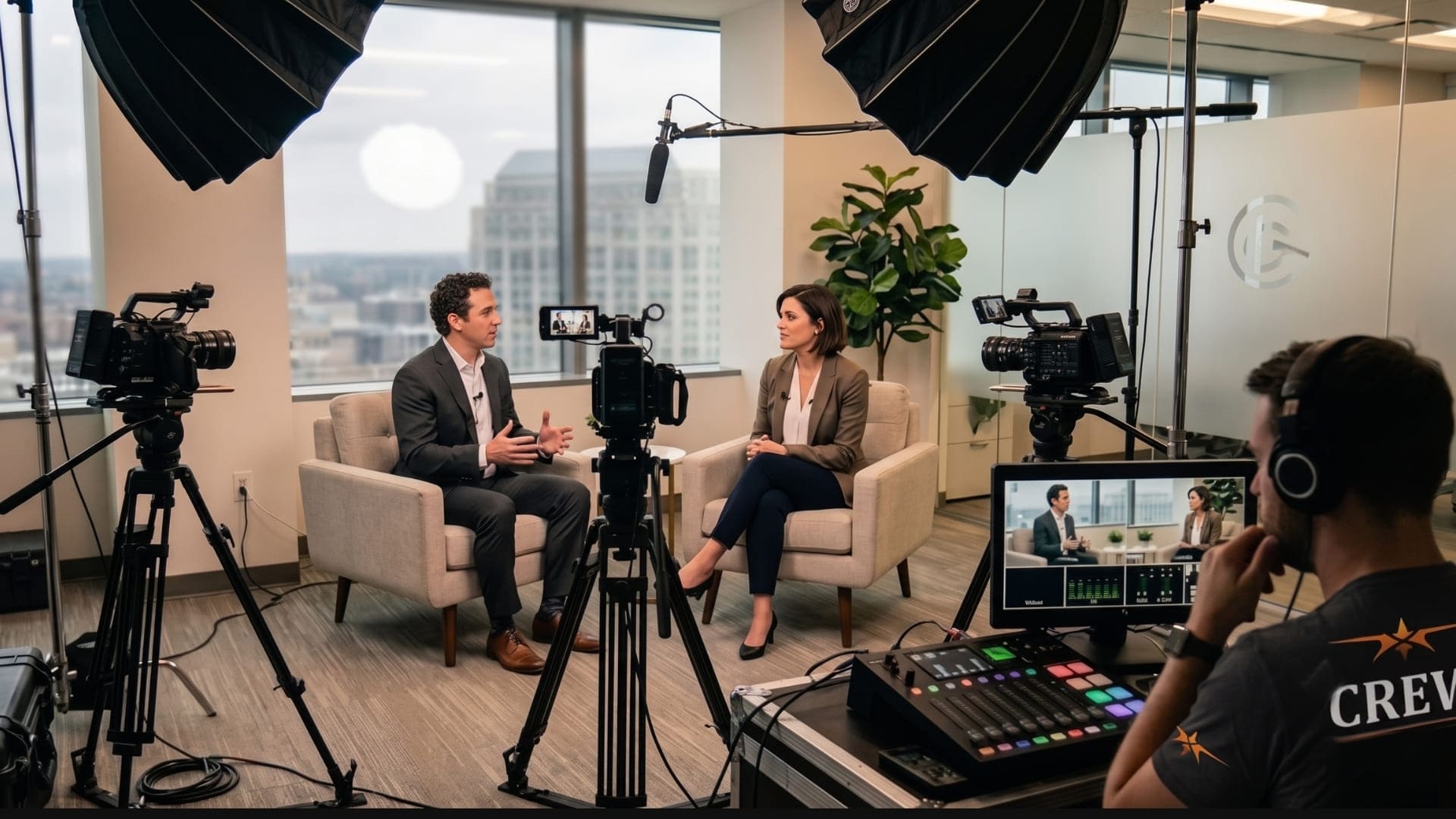
Get featured on the publication’s podcast or video series
Video carries a kind of credibility and shelf life that no written piece can match. A podcast or video feature hosted on a publication’s YouTube channel doesn’t just get watched once; it serves as a lasting reference, resurfaces through search, and gets shared and re-shared long after the original publish date. For an industry where buying decisions often involve research over weeks or months, having a credible, independently-produced video in the mix at the moment someone is evaluating partners is a significant advantage.
There’s a second benefit that’s easy to overlook: video and podcast formats are the best way to capture a founder’s or technical lead’s personality and expertise directly. A case study tells the audience what a company built; a video lets them hear how the people behind it think, which builds personal credibility for the individual, not just brand recognition for the company.
Pursue panel discussions and event participation deliberately
Panel discussions, trade show sessions, and industry events organized by publications offer a different kind of opportunity altogether, providing live, in-person visibility rather than published content. A panel seat puts a named individual in front of end users, architects, and PMCs simultaneously, in real time, as a recognized voice in the room. That’s a meaningful step up from “company that did good work” to “person the industry consults.”
The practical point most companies miss: panel seats are something to apply for, not something that happens to you. Publications and event organizers are generally looking for credible, articulate panelists. Founders and technical leads who proactively put themselves forward, rather than waiting to be invited, get far more of these opportunities than those who don’t.
The payoff that extends this further: every panel appearance, trade show session, or booth conversation is a ready-made source of short-form video. A sharp 30-second clip, a strong opinion stated clearly, a confident answer to a tough question, or a clear prediction about where the industry is headed turns one live moment into an asset that keeps working long after the event ends. Most companies get this wrong by posting a generic wide shot of someone sitting on a stage; the dip needs a clear, quotable moment to actually stop a scroll.
Product review videos: The sales-enablement layer
This deserves its own space because it serves a fundamentally different purpose than everything above. Case studies and thought-leadership content build reputation broadly in the market. A well-made product review video is something a sales engineer can drop directly into a live client conversation, “here’s our independent take on this specific DSP, camera system, or control platform,” to support a deal already in motion.
The credibility mechanism here is the mirror image of the publication-built case study. There, credibility comes from the publication reviewing the AV company’s work with neutrality. Here, credibility comes from the AV company reviewing someone else’s product with the same neutrality, including being honest about its limitations. A company willing to point out where a product falls short earns far more trust than one that only ever has good things to say about everything. Over time, a library of these reviews positions the company as a genuine technical authority, not just an installer, and it’s one of the few content formats that directly supports a sale, rather than only building brand awareness.
Client testimonials: Trust in the buyer’s own words
Every format covered so far borrows credibility from elsewhere, whether an editor’s neutrality, a panel’s audience, or a reviewer’s technical standing. A client testimonial is different: it’s the voice of the buyer themselves, a peer of the next prospective client, describing the experience of working with the company in their own words. For someone doing diligence on a potential AV partner, hearing it from another facilities head, hotel GM, or hospital administrator who sat in the exact same chair often carries more weight than any amount of expert or editorial validation.
This belongs in the same documentation discipline as everything in our previous article. The right moment to record a testimonial is at project handover, not weeks or months later. The client is on site, the experience is fresh, and goodwill is at its highest. Waiting for “a good time” usually means it never happens.
A few things separate a testimonial that builds trust from one that quietly undermines it. Keep it short and conversational rather than scripted; a stiff, over-rehearsed answer reads as fake and works against the very credibility it’s meant to build. Ask for a specific moment or result rather than a generic compliment. “What was one thing that surprised you about working with us?” produces a far more useful answer than “Would you recommend us?” And because these clips are quick to produce and don’t depend on anyone else’s editorial calendar, they belong in the steady, high-frequency layer of content rather than the occasional flagship layer.
Social media: The amplifier, not the source
Everything above is the substance. Social media, and LinkedIn in particular for this industry, is how that substance gets distributed and kept visible day to day. The mistake to avoid is treating social media as the place where original ideas are dreamed up; it works far better as the place where flagship content gets cut into smaller pieces and kept circulating.
A few specifics worth getting right. Personal profiles consistently outperform company pages for this kind of audience. Posts from a founder’s or technical lead’s own profile tend to reach and engage significantly more of the target audience than the same content posted from a company page, so a lean team should prioritize its limited effort there first. Tagging is a distribution mechanic, not a courtesy: tagging the client, the architect, the PMC, and any brand partners on a project post means the post now has a chance of reaching each of their networks too, which is how reach compounds in a B2B field where everyone’s network overlaps with someone else’s potential next client. One of flagship asset should always become many posts. A single case study, panel appearance, or product review can be cut into a short clip, a carousel summarizing the key numbers, a text post highlighting one striking detail, and a repost when the publication’s version goes live, each one a separate moment of visibility from one piece of underlying work.
What to post most frequently
Given limited time and a lean team, three content types should make up the bulk of regular posting because they require the least new effort while still carrying real credibility:
- Event shorts, drawn from every tradeshow visit, panel appearance, or site walkthrough, are the steady drumbeat that keeps a page looking active between flagship case studies. They’re also the format current social algorithms reward most consistently.
- Client testimonial reels, captured at the close of every project, bring the buyer’s own voice into the feed regularly rather than only on the rare occasion a flagship case study is ready.
- Reposts or excerpts from publication-led thought-leadership articles, such as a key statistic here and a short personal take there, turn one quarterly article into several weeks of low-effort content that still carries the credibility of an independent byline.
Together, these three formats form the always-on layer that keeps a page active, while case studies, original thought-leadership pieces, podcast features, and panel appearances form the occasional, high-impact flagship layer pursued deliberately rather than left to chance.
The website: Where all of this should ultimately lead
Every channel discussed so far, including publications, panels, podcasts, social media, and testimonials, exists to send someone, eventually, to one place: the company’s website. And this is where much of the effort described above quietly goes to waste, because most AV consultants and SIs treat their website as a formality rather than a sales tool.
The common assumption is that having a website simply tells the world a company exists, a digital visiting card. What this assumption misses is that the website is where a prospective client’s evaluation actually starts, almost always before any human conversation happens. A facilities head shortlisting integrators, an architect checking out a potential partner, and a PMC vetting a vendor for a tender will all visit the website first, often forming a first impression before anyone picks up the phone.
The impression a poor website creates is more damaging than founders realize. A site that’s outdated, slow, thin on content, or clearly an afterthought sends an unspoken but unmistakable message: “If this company isn’t interested enough in its own business to present it properly, why would it take real interest in mine?” That single impression can undo weeks of credibility carefully built through a publication feature or a strong panel appearance, because the visitor’s very next click, after seeing the feature, is usually to the company’s own website to verify it.
This is exactly why the website deserves to be treated as a 24-hours sales tool rather than a static brochure. It is working, or quietly failing, even when nobody on the team is awake to follow up.
A website built this way doesn’t just tell the world a company exists. It becomes the most patient, thorough, and always-available member of the sales team, one that never sleeps, never misses an enquiry, and never fails to show a prospective client exactly what the company is capable of.
Closing the loop
None of this works in isolation from what we covered previously or from each other. The case study library is the raw material; publication partnerships and client testimonials are where that material earns independent credibility; social media is how that credibility stays visible week after week; and the website is where all of it should ultimately converge, so that a prospective client arriving there for the first time finds the full weight of the company’s work and reputation in one place, rather than scattered across platforms the company doesn’t fully control. And the ROI metrics from our last discussion, including enquiries that reference a specific feature, qualified leads from architects and PMCs, and visibility among a defined list of target accounts, are exactly what this distribution effort, website included, should be measured against.
The companies that get this right won’t be the ones posting the most. They’ll be the ones who turn their best work, their clients’ own words, and their own website into a visible, credible, compounding presence, in front of the people who actually decide who gets the next project.