The modern church is no longer defined solely by its theology. Increasingly, it is defined by its technology. Across the world, houses of worship, from centuries-old cathedrals to purpose-built auditoriums, are grappling with a fundamental shift. Congregations now expect to hear clearly, see vividly, and connect digitally, whether they are in the room or streaming from a living room ten thousand miles away. For the AV and systems integration industry, faith has quietly become one of the most demanding and dynamic verticals. The buildings are diverse, and the budgets vary enormously. Yet the ambition is converging, and the pace of change has never been faster.
Picture two scenes, twenty kilometres apart. In the heart of Chennai, a technician threads a speaker cable between the carved columns of a century-old stone church. Quiet work, done with care. On the outskirts of Bengaluru, a steel-frame auditorium is rising, with five thousand seats, a rigging grid, and a control room that would not look out of place in a broadcast facility. Both are churches, both investing in technology. Almost everything else about them is different.
South India has one of the world’s oldest and most layered Christian heritages, spanning the first-century Syrian churches of Kerala and the colonial-era Catholic parishes of the Coromandel Coast. Alongside these ancient institutions, a new generation of Pentecostal and Charismatic congregations has grown rapidly since the 1990s economic liberalisation.
For the AV and systems integration industry, these two worlds represent a compelling and complex opportunity. Knowing the difference between them is where every successful project begins.
The traditional church – rooted, renovating, resilient
India’s traditional churches, Catholic parishes, CSI and CNI congregations, the Syrian Orthodox and Marthoma communities of Kerala, and the Anglican churches of the north share a defining characteristic: stable, multigenerational congregations rooted in community, language, and place. They do not compete for footfall. They do not build new. Their investment cycle is one of upgrading, not expansion.
Yet they are quietly spending. A failing PA system, a new parish council, or the need to reach diaspora communities in the Gulf, the UK, or North America can unlock budgets that were previously unavailable. Livestreaming has become a pastoral necessity for congregations whose members are scattered across continents.
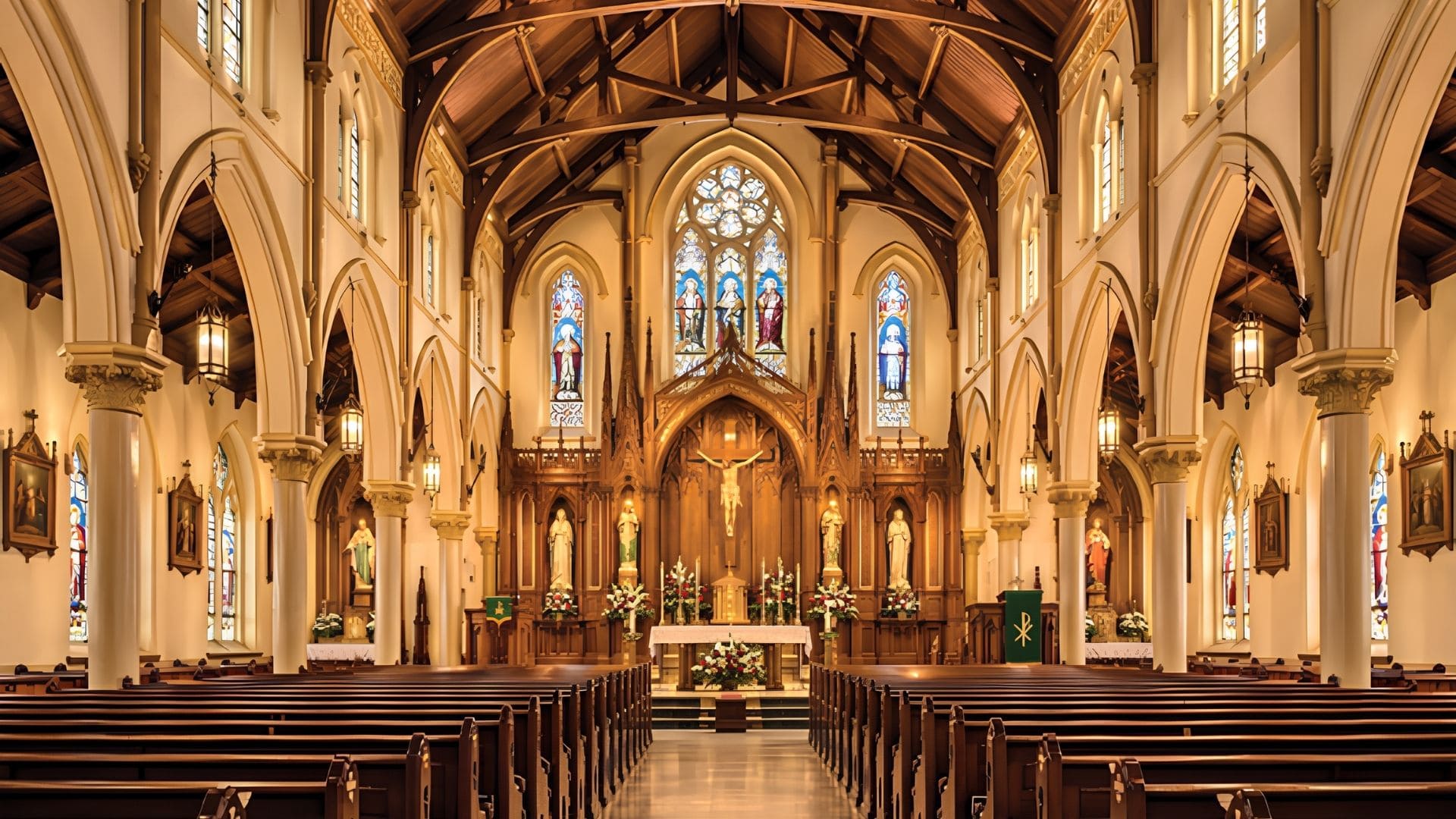
The technical and commercial challenges are real. Heritage buildings, stone walls, vaulted ceilings, and protected interiors require careful acoustics and regulatory patience. Decision-making is slow and committee-driven. But for integrators willing to work at that pace, the relationships are deep and loyalty is enduring.
The independent church – fast, loud, and expanding
Since the 1990s, Pentecostal and Charismatic congregations have proliferated across India’s cities, with some emerging from small prayer groups and others deliberately planted by larger organisations. What they share is a model that places the worship experience at the centre of growth strategy, treating AV and production technology not as a luxury but as a strategic imperative.
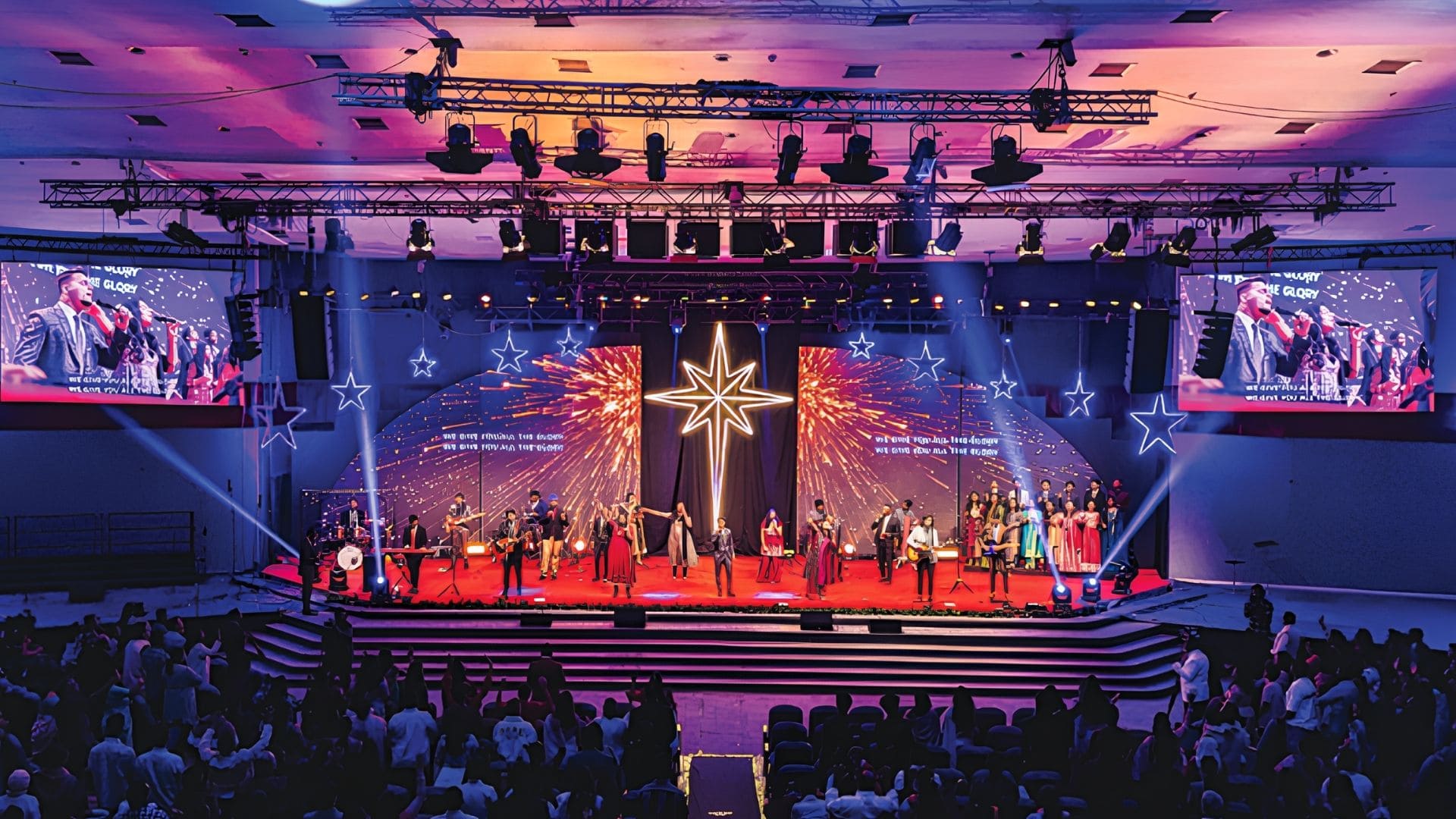
As land prices in city centres have become prohibitive, independent churches have moved to the urban fringe, highway corridors, new suburbs, and semi-rural outskirts, where there is space to build at scale. The structures rising outside Bengaluru, Hyderabad, and Chennai are purpose-designed worship facilities: seating for two to ten thousand, sophisticated rigging grids, broadcast control rooms, and acoustics that would satisfy any arena engineer.
The driving logic is congregation retention. Unlike traditional churches, where membership is inherited, independent churches actively compete for worshippers. Pastoral leadership and theology matter, but so does the Sunday experience. Production values determine whether so

MD & CEO of Ansata
meone returns next week or quietly drifts to the church down the road with a better speaker system.
Leslie Lean, MD & CEO of Ansata, puts it plainly: “It’s like an economic spectrum, from the very basic to the extravagant. The bigger congregations, including AG and Pentecostal churches, spend in crores. Their core priority is ensuring the word of God reaches every corner of the room. But the more evolved city churches want an experience, proper musicians, professional sound, and quality acoustics. These are churches creating new communities and campuses. They see AV as central to what they’re building. Sound is not a luxury for them. It is the worship.”
That ambition is reflected in the technology these churches now demand, including full line arrays, large-format LED walls, theatrical lighting, broadcast-grade IMAG, in-ear monitoring, digital consoles, and streaming infrastructure that reaches online audiences that often rival the size of the room. App-based giving, multilingual interpretation, and overflow relay are fast becoming standard expectations.
Technology as theology
The faith sector has matured significantly over the past decade. Once treated as minor corporate installations, church projects are now approached with a sophistication that rivals that of premium hospitality or live events clients. Leading independent churches arrive with reference sites visited, YouTube channels analysed, and a clear acoustic and visual vision. The conversation has shifted from ‘what do we need?’ to ‘how do we achieve what we’ve seen elsewhere?’
This shift extends beyond the independent church. Traditional congregations are also recognising that the worship experience depends fundamentally on what people can hear. Claron D’Souza, Co-Founder of AuralEdge Technologies, has witnessed this change firsthand. “Priests and parishioners have begun to understand that the point of coming to church is lost if you can’t hear anything. Earlier, they would always say, ‘We don’t have money.’ Now the priest says, ‘If it’s the best thing to do, let’s do it, I’ll find a way to get the money.’ That is a big step in the right direction.”
That evolving mindset, however, brings its own challenges. Not every church has access to the right expertise. “Church systems don’t need big touring line arrays with massive boxes hanging in the middle of the nave. That destroys the ambience. Sound in a church should be invisible. It should not be a distraction. The design is never copy-and-paste. Every church is different, and the right solution has to be tailored to the space, the congregation, and how they worship.”

Co-Founder, AuralEdge Technologies
The multi-site model is reshaping how integrators approach these projects. Larger independent churches now run a single central service, distributed via video relay to satellite campuses. This demands network infrastructure, video distribution engineering, and remote production capabilities that firmly enter enterprise AV territory.
Audio remains the most technically demanding component. Line arrays are now the standard for large-format builds, with cardioid subwoofer configurations increasingly used to manage low-frequency energy in reverberant spaces. Achieving simultaneous speech intelligibility and musical impact in hard, reflective rooms built for large congregations is what separates experienced church specialists from generalist installers.
Video has followed a parallel path. LED walls have largely replaced projection in new builds, offering the brightness and versatility to serve as both a lyric screen and a full-stage backdrop. IMAG is now considered essential above roughly fifteen hundred seats, and broadcast-quality streaming has become a standard line item rather than an optional extra.
The faith economy
The commercial landscape reflects the divide between the two institutional types. Traditional church upgrades typically range from ₹20 lakhs to ₹2 crores, depending on scope. These projects are valuable, but extended decision timelines and conservative procurement mean integrators must manage relationships over a longer horizon.
Independent church projects can be substantially larger. A new-build auditorium may carry an AV and systems budget of ₹5 crores to ₹50 crores or more, covering audio, video, lighting, control, networking, and broadcast infrastructure. Funded through tithing, donor campaigns, and occasionally institutional borrowing, these projects can see timelines shift with financial position, but when a build is underway, investment appetite is often significant.
Recurring revenue remains an underexplored opportunity. Both church types require ongoing support, maintenance contracts, and periodic equipment refreshes. Christmas and Easter are predictable annual revenue peaks for integrators with established relationships. Those who invest in long-term partnerships rather than transactional delivery find the faith sector offers loyalty and continuity that compare favourably with more competitive commercial verticals.
What’s next for worship
Several trends are converging to reshape church AV over the coming decade. Hybrid worship has moved from a pandemic necessity to a permanent expectation. Churches that invested in streaming in 2020 and 2021 found their online audience had become a congregation in its own right, prompting fresh investment in broadcast control rooms, fibre networks, and cloud-based streaming workflows.
Automation is emerging as a practical response to the shortage of trained technical volunteers. Automatic microphone mixing, robotic camera tracking, and AI-assisted tools for noise reduction and feedback suppression are entering live church environments, significantly reducing the skill requirements for routine services.
The multi-campus model is likely to proliferate further. As congregations outgrow their primary venue, the economics of a well-equipped satellite campus, connected via reliable video and audio distribution, are increasingly compelling, driving demand for integration expertise spanning network engineering, broadcast, and venue AV within a single scope.
Traditional churches, meanwhile, are not standing still. Diaspora connectivity is accelerating investment in broadcasting, even within conservative institutions. As generational change brings younger leadership into church governance, the appetite for technology is quietly but steadily growing.
The bigger picture
India’s churches are not competing with one another, not in any theological sense. They are communities of faith pursuing the same purposes of worship, community, and service. Yet the infrastructure through which those purposes are pursued has never been more varied or technically demanding than it is today.
For integrators who have built their practice around the faith sector, this market rewards patience, expertise, and genuine relationships. These are not transactional projects. They are long-term partnerships with clients whose decision-making moves slowly, whose budgets are hard-won, and whose expectations, once met, generate the most powerful currency in the industry: word of mouth.

Founder-Zacs-N-Phils
Manu Philip, Founder at Zacs N’ Phils, one of Kerala’s most experienced church-focused integrators, speaks from a decade on the ground: “When I entered this industry, people only knew Ahuja. When we mentioned JBL or column speakers, they were completely unaware. It took three years just to install the first column speaker, three years spent educating architects and parish priests. But once that first install was done and people heard the clarity, word spread fast. Budgets that were once one and a half to two lakhs have grown to ten, eighteen, twenty-five lakhs and beyond. The shift has come from the congregation itself. They started complaining that sermons were inaudible. Speech intelligibility has overtaken everything else. Earlier, the choir wanted it loud. Now the committee wants clarity. That is the real change we are seeing on the ground.”
That change is being felt across the country. Whether the commission is a discreet speaker upgrade in a granite church that has stood for two centuries, or a full production system for a new auditorium on a Bengaluru ring road, the brief is the same at its core: help people hear, see, and feel something that matters. For the integrators who get it right, the faith sector offers something few other verticals can: work that carries meaning well beyond the technical.