As higher education institutions seek to bridge the gap between theory and real-world application, immersive experience centers are emerging as powerful tools for engagement, skilling, and industry readiness, creating significant opportunities for the AV industry.
For generations, the classroom has been the heart of higher education. Yet in a world where students consume information through videos, simulations, social media, artificial intelligence, and immersive digital platforms, traditional teaching methods are increasingly challenged.
Today’s learners have unprecedented access to information. What they often lack, however, is context, application, and experience.
This shift is prompting some of India’s leading educational institutions to rethink how learning is delivered. Beyond smart classrooms and lecture capture systems, a new category of learning environments is emerging, including experience centers, immersive learning spaces, and industry-linked centers of excellence that allow students to interact with knowledge rather than simply consume it. While adoption remains limited, industry experts believe these spaces could fundamentally reshape higher education over the next decade.
The rise of experiential learning
According to Manmohan Ganesh, Managing Director of ProFX, a veteran AV industry leader who has worked on several educational projects, experience centers should not be confused with traditional laboratories or simulation environments.
“An experience center is essentially a storytelling medium,” he explains. “It uses audio, video, interaction, and immersion to create a lasting impression. A simulation lab is different because students actively test and validate concepts. Experience centers are especially effective at helping people understand and remember.”
That distinction is increasingly important as educational institutions explore new ways to engage students. Unlike conventional classrooms that rely primarily on lectures and presentations, experience centers create environments where students can see concepts unfold, interact with digital content, explore scenarios, and develop a deeper appreciation for the subject matter.
“There’s nothing like actually seeing something,” says Manmohan. “You can be told about something, but that’s not enough. Learning becomes much more powerful when students can experience it.”
The concept is not entirely new. Planetariums have long served as immersive educational environments that help visitors understand astronomy through visualisation and storytelling. Today’s educational experience centers apply similar principles across disciplines, from engineering and healthcare to law and environmental science.
Not every experience center serves the same purpose
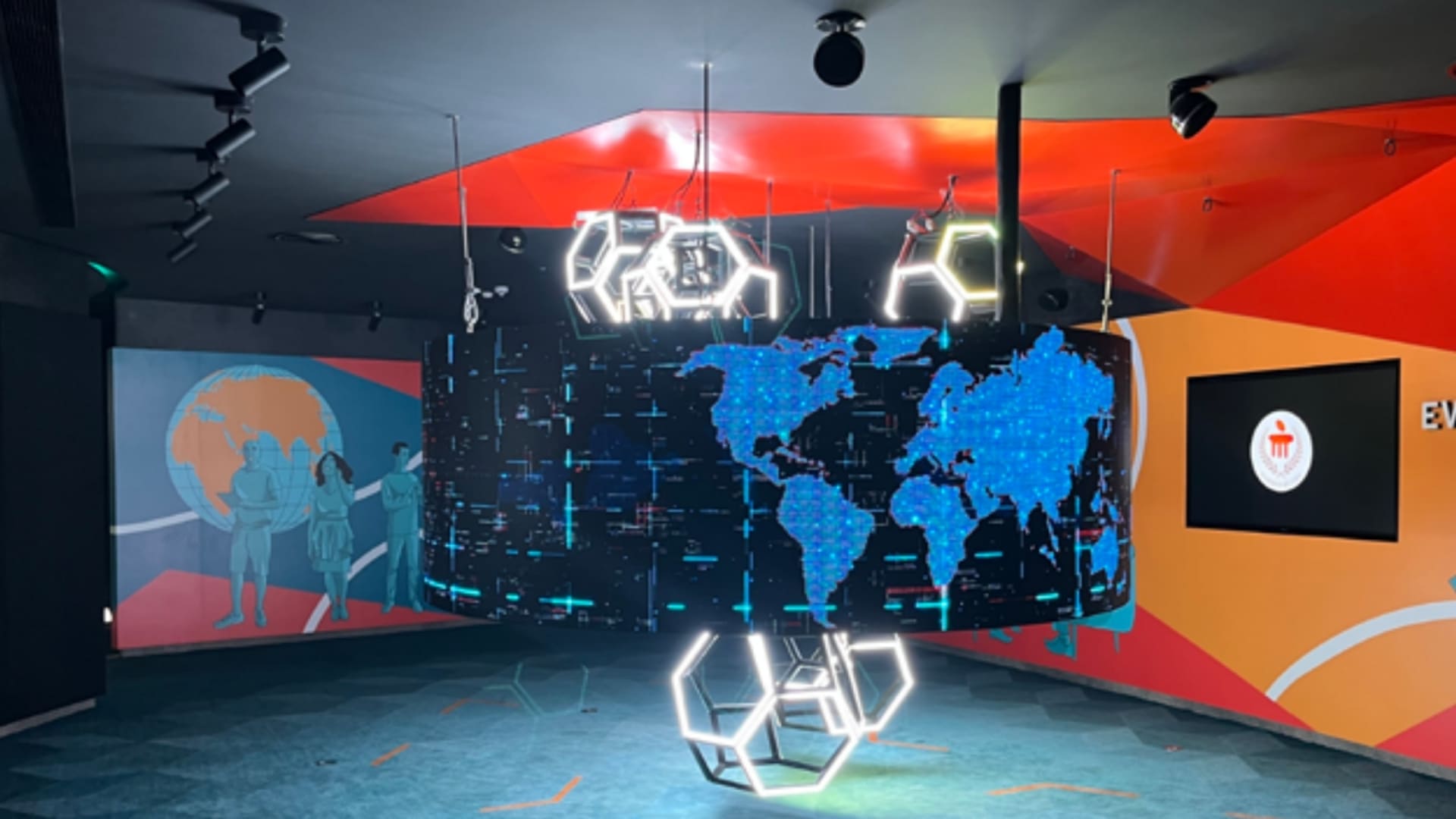
One of the key insights from our discussions with industry leaders was that educational institutions are deploying experience centers for a range of objectives. Manipal University’s experience center is a case in point. While highly immersive and technologically sophisticated, its primary purpose is not curriculum delivery. Instead, it serves as an institutional storytelling platform.
“It is more about inspiring students and parents,” explains Manmohan. “It showcases alumni achievements, patents, innovations, and how education can transform lives. Indirectly, it becomes a very powerful admissions and engagement tool.”
This represents one category of experience center. The second category is far more closely linked to learning outcomes. These immersive environments are designed to help students understand concepts, develop practical skills, and build industry readiness. This second category is beginning to attract attention from progressive educational institutions.
Bridging the gap between academia and industry
For Sunil Subramanian, Senior Vice President of Business Development at EDDC, the biggest challenge facing higher education today is not access to information but the inability to translate knowledge into practical skills.
The quests are now coming from the institutions. They are approaching consultants and system integrators with clear objectives
Vipin Verma
“The gap between education and industry remains significant,” he says. “Students understand theories, concepts, and processes, but they often struggle to see how they apply in the real world.”
According to Sunil, students today face information overload rather than scarcity.
“There are thousands of videos online on almost any subject. But knowledge alone does not create competency. Students need opportunities to touch, feel, interact, and experience.”
He believes that experience centers and centers of excellence play a critical role in bridging three key pillars: Learning, Competency, and Employability.
A civil engineering student may understand different grades of cement from a textbook, but may never have physically handled the material or understood where and why it is used. Similarly, a medical student may study anatomy extensively but benefit enormously from immersive visualization technologies that reveal structures layer by layer.
“Experience centers help students develop appreciation,” says Sunil. “And appreciation is what ultimately transforms knowledge into skill.”
KPR Institute’s engineering experience center: A blueprint for the future
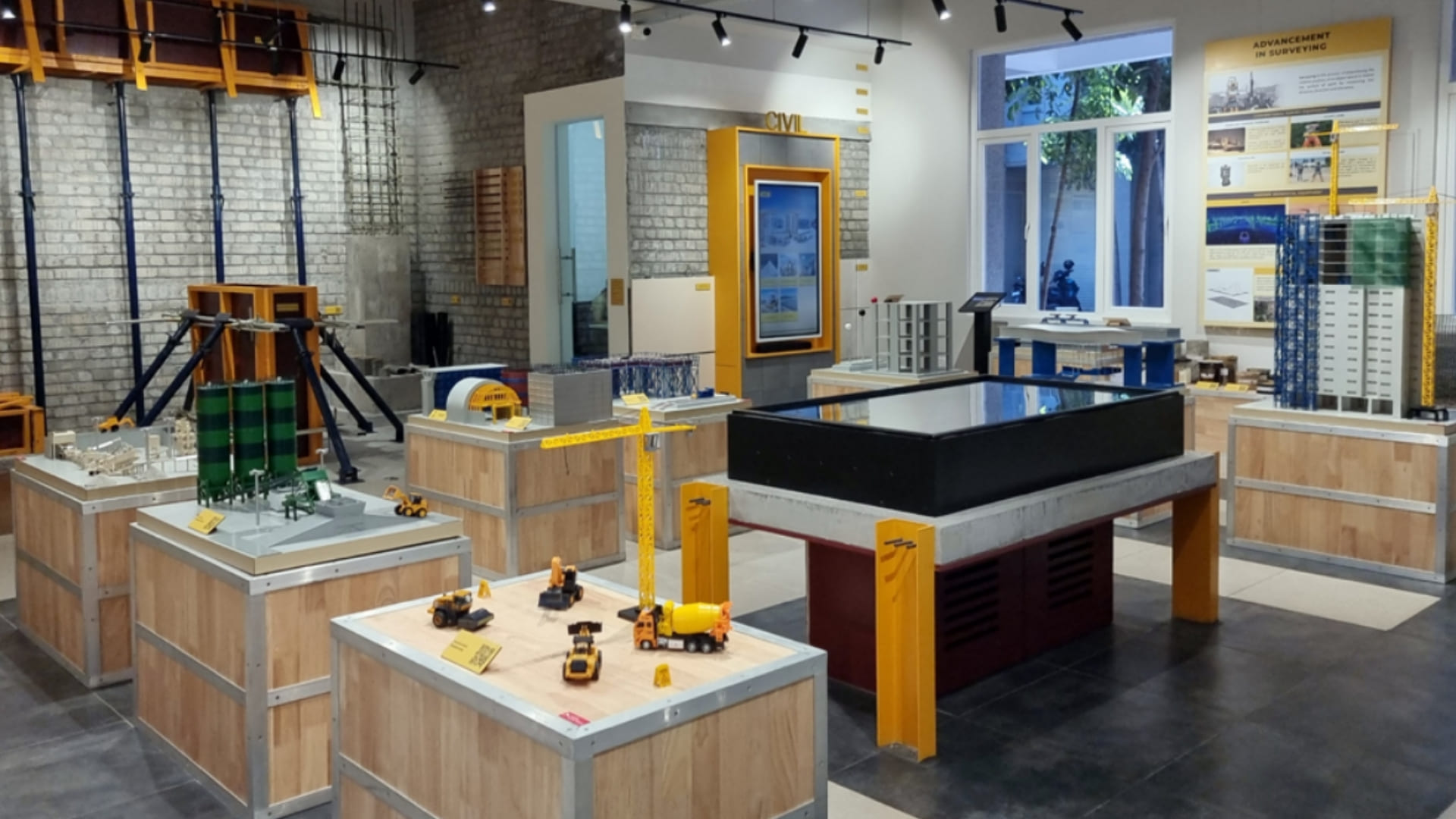
Perhaps one of the most compelling examples of experiential learning in India is the Engineering Experience Center at KPR Institute of Engineering and Technology, developed in partnership with Larsen & Toubro. The project was conceived to address a growing concern in engineering education: students were graduating with strong theoretical foundations but limited exposure to industrial practices.
“KPR had a vision,” recalls Sunil. “They wanted students to understand how industry actually works, not after graduation but during their education.”
The result was a nearly 4,000-square-foot experiential learning center developed through collaboration among KPR Institute, L&T, and TDDC.
The center combines physical engineering exhibits, interactive displays, virtual reality, augmented reality, BIM demonstrations, industry workflows, and collaborative learning environments.
Students not only learn concepts but also understand how infrastructure projects are designed, executed, monitored, and managed.
Industry experts regularly engage with students through workshops, demonstrations, and mentoring sessions.
Today, the center is an integral part of the learning process, rather than a showcase facility.
“It is occupied almost every day,” says Sunil. “Students spend dedicated hours just as they would in a classroom or laboratory.”
More importantly, it has strengthened industry-academia collaboration, directly benefiting students.
Educational institutions are beginning to recognize the opportunity
Although adoption remains relatively low, there is growing evidence that institutions are beginning to recognize the value of experiential learning.

Founder, Consultechpro
Vipin Verma, Director of ConsultPro, an AV consultant involved in several large-scale education projects, believes demand is increasingly driven by universities themselves.
“The realization is definitely happening,” he says. “The requests are now coming from the institutions. They are approaching consultants and system integrators with clear objectives and asking for solutions that can improve engagement and learning.”
He points to projects such as Science Gallery Bengaluru and several emerging immersive educational initiatives that combine physical, digital, and live-learning experiences. One particularly interesting project nearing completion is a 250-seat educational planetarium designed for real-time astronomy learning.
“This is not just a planetarium,” explains Vipin. “Students will learn through live satellite connectivity, real-time observations, and interactive educational sessions. It becomes a true learning environment.”
Such projects demonstrate how educational experience centers are evolving from static displays to dynamic, continuously updated learning ecosystems.
The content challenge
While discussions about experience centers often focus on displays, projection systems, interactive technologies, and immersive environments, all three contributors agree that technology is only part of the equation.
The real challenge lies in content. Many institutions express interest in creating immersive learning environments, but struggle to identify where the content will come from. According to Manmohan, this is one of the biggest barriers to adoption.

“Institutions frequently tell us they want to create immersive biology experiences or interactive learning modules. But then the question becomes: where is the content?”
Creating educational content is not simply a matter of producing attractive visuals. Scientific accuracy, pedagogical relevance, curriculum alignment, and technical precision are essential.
“You cannot simply ask a video creator to build a medical simulation,” says Manmohan. “The content must be accurate. Sizes, colors, structures, everything has to be right.”
Vipin agrees that content development is a rapidly growing segment of the market.
“The demand for specialized content creation is increasing significantly,” he notes. “There are agencies focused entirely on immersive content, projection mapping, and experiential storytelling.”
As AI-driven content creation tools mature, industry experts expect this challenge to become easier to address, accelerating adoption across the education sector.
Opportunities for the AV industry
For AV consultants and system integrators, educational experience centers are among the most exciting growth opportunities in the coming years.
However, success will require a different approach.
“Many people set up a room and call it an experience center,” says Sunil. “But that’s not enough.”
Instead, consultants must focus on delivering complete educational ecosystems. This requires expertise in learning design, experience design, content strategy, technology integration, industry collaboration, and user engagement.
Sunil believes the most successful projects integrate multiple layers.
“When we design these environments, we bring together pedagogy, technology, content, applications, and space design. All these elements must work together.”
The AV industry’s role is therefore evolving from a hardware supplier to a learning experience partner.
The technologies driving experience centers
The technologies powering these environments continue to evolve rapidly.
Today’s projects typically integrate a variety of advanced technologies, including large-format displays, interactive touchscreens, LED walls, and projection mapping systems. They often feature virtual reality platforms and augmented reality experiences that enhance engagement and interaction. In addition, spatial audio systems contribute to immersive soundscapes, while lecture capture solutions facilitate the documentation of sessions. Moreover, collaboration technologies play a crucial role in facilitating teamwork and communication among participants.
Artificial intelligence is emerging as the next major layer. According to Sunil, future experience centers will increasingly feature conversational AI interfaces and digital avatars that guide students through their learning journeys.
“We are already creating AI-powered experiences where students can interact with virtual guides and ask questions naturally,” he says.
Robotics is also finding a place in educational environments.
“We use AI robots that welcome visitors, explain exhibits, guide students, and enhance engagement,” he adds.
Looking ahead
Despite modest current adoption, all three contributors agree that the future is bright. Manmohan predicts that immersive learning environments will become far more common over the next three to five years as content creation becomes easier and educational institutions gain greater confidence in the model. Vipin sees universities increasingly driving these initiatives from within, reflecting a growing awareness of the importance of engagement and experiential learning. Sunil believes the broader transformation is already underway.
“The classroom alone is no longer enough,” he says. “Students need experiences that connect learning with industry, with skill, and with their future careers.”
For educational institutions, experience centers offer a pathway to more engaging, relevant, and impactful learning. For students, they provide opportunities to move beyond theory and develop practical understanding. And for the AV industry, they represent an opportunity to play a strategic role in shaping the future of education.
The classroom is no longer the student’s entire world. Learning must extend beyond the classroom to experiences that build understanding, competency, and industry readiness.
Sunil Subramanian